
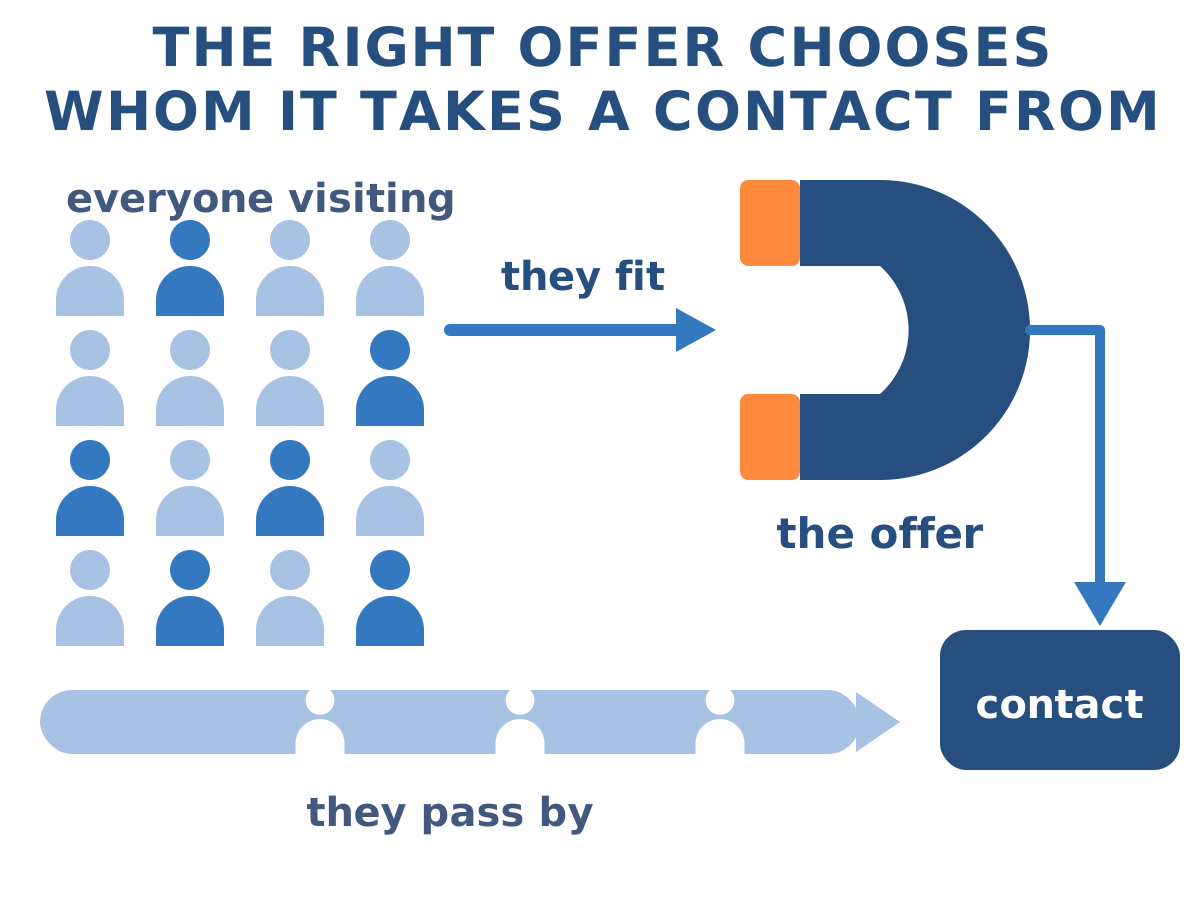
A lead magnet is something useful offered in exchange for contact details. It is the mechanism that turns an anonymous reader into a named contact, and it is where the wider work of B2B lead generation becomes concrete. The whole subject reduces to one question the visitor answers in a few seconds: is this worth my email address?
What is a lead magnet?
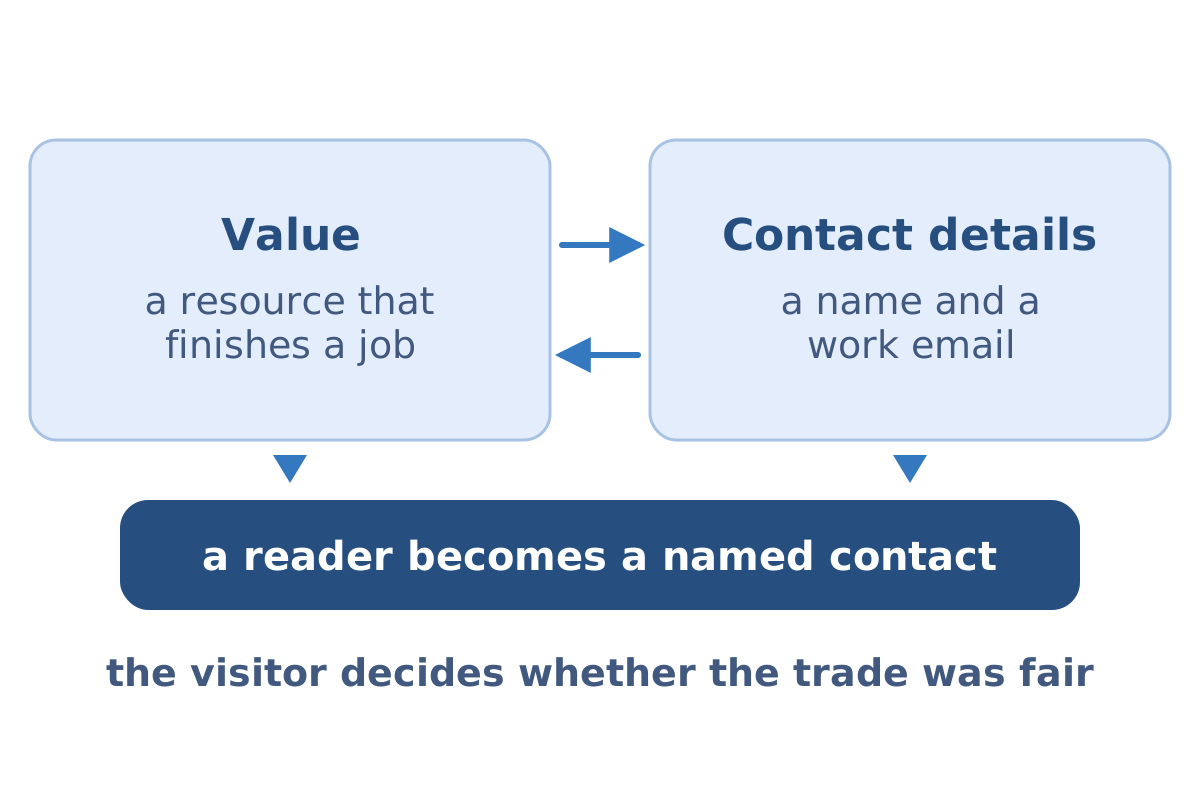
A lead magnet is a free resource — a document, a tool, a session, a sample — given to a visitor in return for their contact details and their consent to be contacted. The currency is the data, not money.
Four attributes make the exchange work:
- It is specific. It solves one problem for one kind of person. A resource aimed at everyone attracts contacts worth nothing to anyone.
- It is immediate. The value arrives on delivery, not after weeks of use.
- It is self-contained. It does the job on its own, without a purchase.
- It is close to what you sell. This is the attribute most often missed. A resource with wide appeal but no relationship to your offer fills a list with people who will stay strangers.
That fourth point is the difference between a large list and a useful one. The purpose of a lead magnet is qualification as much as collection: the right offer attracts the right people and is quietly ignored by everyone else, which is a feature.
How do lead magnets work?
A lead magnet works by converting attention that already exists into a record you can act on. The sequence has four steps, and each one leaks.
A visitor arrives with a question, usually from search. They encounter an offer that extends the answer they came for. They exchange their details through a form. They receive the resource, and the relationship begins.
The step that decides the outcome is the second one, because relevance is what carries the exchange. An offer that continues the reader's current train of thought converts; the same offer placed on an unrelated page does not. This is why lead magnets are built alongside content rather than after it.
It is worth being precise about what conversion rate to expect, because the figures that circulate describe different things. In drySEO lab data, a knowledge-led site converts visits into commercial enquiries at 0.8% — 0.7% after noise is removed (denominator: all site users ÷ commercial enquiries in the CRM; drySEO lab data). Funnel templates in circulation quote around 5% for the same step, and the gap between the two is a difference of denominator: 5% describes a campaign landing page addressing people already in the market, while a knowledge site's denominator is everyone who arrived, most of whom came to learn something. The two numbers answer different questions, and each is right about its own.
What makes a good lead magnet?
A good lead magnet gives the visitor a result they can use today, in a form that takes minutes rather than hours. Five tests separate the ones that work from the ones that sit unread.
Does it finish a job?
A checklist that completes a task beats a report about the task.
Can it be consumed quickly?
A long document is a promise to spend an evening. Most people decline.
Does it demonstrate competence?
The resource is a sample of your thinking, and it will be judged as one.
Would someone pay for it?
If the honest answer is no, the offer is unlikely to be worth an email address either.
Does it lead somewhere?
The resource should leave the reader with a clear next question that your business answers.
In business-to-business markets one further test applies. The resource has to survive being forwarded, because the person who downloads it is frequently not the person who decides. A document that makes sense to a colleague who never visited your site is doing a second job entirely.
What are examples of lead magnets?
Lead magnet formats fall into four groups by what they give the visitor: a shortcut, an answer, a tool, or access. The right group depends on where the reader is in their thinking.
Shortcuts
save time on a task the reader was going to do anyway: templates, checklists, cheat sheets, swipe files, configuration files. They convert best because the value is obvious before the download.
Answers
supply information the reader cannot easily assemble: original research, benchmark data, specifications, market reports, comparison guides. These work on readers who are evaluating rather than doing.
Tools
produce a result from the reader's own inputs: calculators, selection tools, assessments, audits, diagnostic quizzes. They convert exceptionally well in technical markets, because the output is personal to the user and the act of entering data is itself a qualification.
Access
offers time or experience rather than a file: webinars, recorded sessions, trials, samples, consultations. A recorded session can run continuously once produced, which makes it one of the few formats that keeps working without further effort.
In business-to-business technology and industry specifically, the formats that perform are the ones an engineer can evaluate: a selection tool, a specification, a benchmark, a technical workshop. One rule holds across these markets and is worth stating as a rule — basic product documentation stays open. An engineer asked to complete a form before seeing a datasheet goes to a supplier who publishes one. Gate the premium layer, publish the foundation.
How do I create a lead magnet?
Creating a lead magnet is a five-step process, and the first two steps determine whether the remaining three matter.
1. Pick the audience and the moment
Name one reader and one question they have right now. A resource built for a defined moment converts; a resource built for a topic does not.
2. Choose the promise
Write the outcome in one sentence, as the visitor would describe it. If that sentence is hard to write, the offer is unclear and the form will show it.
3. Build the smallest version that delivers the promise
A one-page checklist that works is better than a thirty-page guide that is still in draft. Production effort correlates poorly with conversion.
4. Build the page and the form
Ask only for what you will use. In B2B, company name and the nature of the enquiry are worth more than five demographic fields, and every additional field costs completions.
5. Set up delivery and what follows
The resource arrives immediately, and the sequence after it is planned before launch rather than improvised afterwards.
The mechanics of the page and form — layout, single call to action, load speed, and how to test them — are set out in the lead conversion guide.
How do I promote and distribute a lead magnet?
A lead magnet is distributed by placing it where the matching question is being asked, which in practice means four places.
Inside the relevant content, at the point where the reader has just learned something and wants the next step. This is the highest-converting placement and the most underused, because it requires matching each resource to specific pages rather than promoting one resource everywhere.
On a dedicated page that can rank on its own for the resource's subject, and that gives you something to link to.
In campaigns, where a concrete offer outperforms a general invitation to get in touch.
Through professional networks and communities, where a genuinely useful resource circulates on its own merits.
The largest and most durable of these routes is search, because it delivers people at the moment the question forms. How search traffic is converted into commercial enquiries is set out in our SEO leads guide.
What happens after the download?
What happens after the download decides whether the lead magnet produced a contact or a subscriber, and this stage is where most of the value is won or lost.
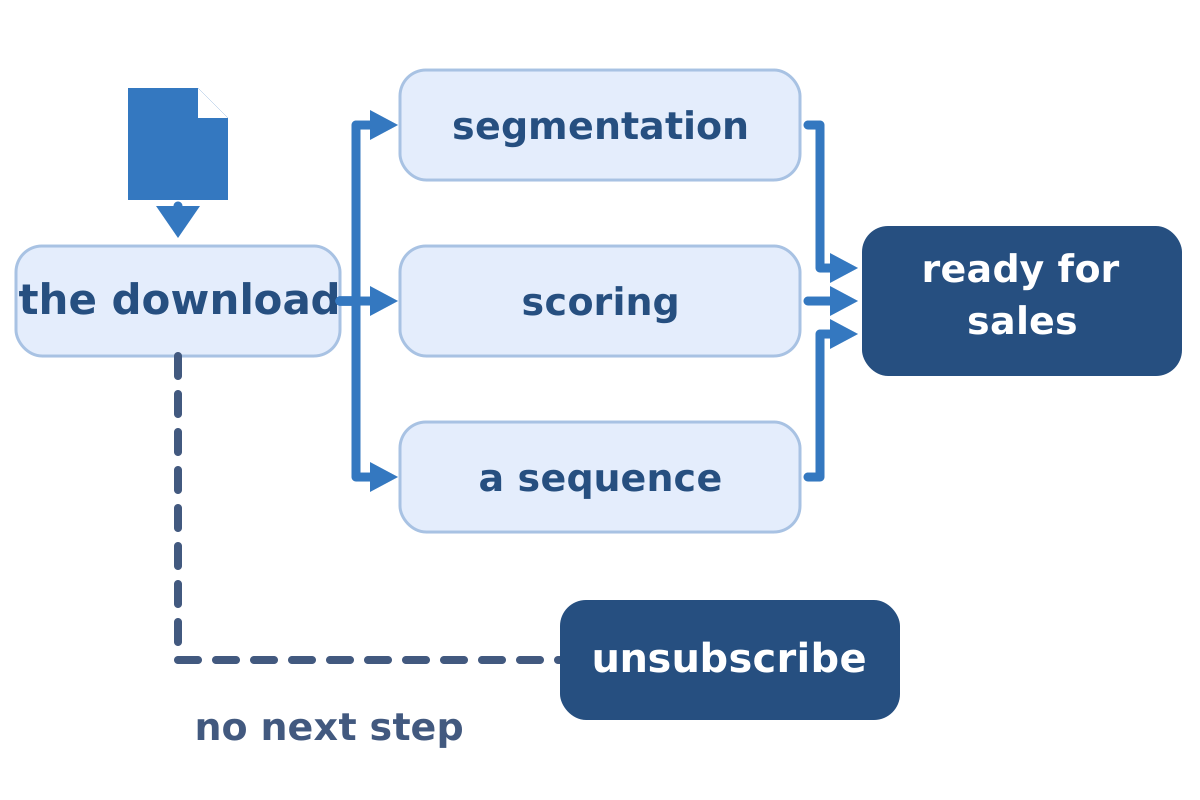
Three things follow the delivery.
Segmentation. What someone downloaded tells you what they are working on. Sorting contacts by resource is the cheapest segmentation available.
Scoring. Behaviour after the download — which pages, which further resources, how often — indicates seriousness better than any form field.
A planned sequence. From drySEO lab practice, conversion of a new client typically follows the fifth contact, with sequences running to twelve follow-ups. It is directional — a pattern from inbound B2B experience, distinct from the measured figures on this page, which carry denominators. The operational consequence is firm: a single follow-up email stops far short of where conversion happens, and a cadence of five to twelve contacts has to be carried by a system.
Measuring the decision window. The window is long. Measured on the lab's last thousand leads, cumulatively: 7.07% of closings came within 3 days, 41.65% within 45 days and 65.96% within 75 days (drySEO lab data — closings ÷ time since the lead's entry; a share of closings, not of leads). Fewer than half of all closings have happened by day 45, and a third of them arrive after day 75. A contact who goes quiet a month after the download is usually early rather than lost.
Email is the usual carrier for that sequence, and its performance varies with how well it is targeted. In drySEO lab practice, B2B newsletter open rates ran 22–25% on average, around 29% with personalisation, and 40–50% with localisation and personalisation together — directional figures from experience, distinct from the measured data above, which carries a denominator. The pattern matters more than the numbers: relevance multiplies attention, and the resource someone chose to download is the best relevance signal available. How that channel is run is covered in Email Lead Generation.
The systems that hold the record, the score and the sequence are covered in the marketing automation guide.
What are common mistakes when creating a lead magnet?
Six mistakes account for most lead magnets that underperform, and each has a direct fix.
Promising broadly
A resource for everyone is chosen by no one. Fix: narrow it until it feels too narrow, then publish it.
Asking for too much
Every form field costs completions. Fix: collect what the next conversation requires, and learn the rest later.
Building too much
Months spent on a substantial guide delay the test and raise the cost of discovering the offer was wrong. Fix: publish the smallest version and improve what proves itself.
Placing it once
A resource on a single page reaches only that page's visitors. Fix: place it in every article whose question it answers.
Gating the foundation
Putting basic documentation behind a form loses technical buyers permanently. Fix: publish the foundation and gate the layer above it.
Stopping after delivery
A contact collected and left alone becomes an unsubscribe. Fix: plan the sequence before launch.
Designing offers that avoid all six, and connecting them to the search traffic that feeds them, is part of the work described in our SEO and SEM services.
FAQ
Does a lead magnet always have to be free?
Yes, in the sense that money does not change hands — the visitor pays with their contact details and their consent. This is an exchange of value rather than a commercial transaction, which is why the resource still has to be worth something: the visitor is making a judgement about whether the trade was fair, and they make it again every time you contact them afterwards.
How do I measure whether a lead magnet works?
Measure four things in order: the conversion rate of the page that offers it, the number of contacts produced, the share of those contacts that become commercial enquiries, and the share that become customers. The first two flatter a bad offer, and the last two expose it. A resource with a high download rate and a low enquiry rate is attracting the wrong people, which is a targeting result rather than a design result.
How long should a lead magnet be?
Short enough to be used the day it arrives. Length is a cost to the reader, and the formats that convert best — checklists, templates, calculators — are valued for compressing effort rather than for expanding on a subject. Where depth genuinely is the value, as with original research, the summary belongs at the top so that the resource delivers something in the first minute.