
drySEO is a lead generation lab, running since 2013. We run our own B2B account as the ground on which a real funnel grows — from the first search visit to the order in the CRM. On that funnel we work out growth methods, test them with measurement, and implement the ones that held their result in our clients' companies.
This page describes what grows in the lab and how its working cycle runs, where the figures published as “drySEO lab data” come from, and who stands behind them.
What a lead generation lab is
A lead generation lab is a company that does four things in turn on its own sales funnel: first it grows something on it — traffic, commercial enquiries, orders — then it works out the methods that produce that growth, tests them with measurement, and implements the proven ones at clients. The funnel is real: one B2B account holding every link at once — search and paid traffic, content, landing page, form, CRM, order. Every link has a counter, and the counters connect, so we can see how much demand enters at the top and how much revenue leaves at the bottom.
That setup gives us three things: a full year of measurement counted the same way and read nine months after the period closed, so that orders from long buying cycles had time to land in the count; freedom to experiment at our own risk; and a known denominator behind every number, because we define and count each one ourselves.
How the lab works
The lab's working cycle has four moves, and each one takes its material from the one before.
Growing
A real funnel grows on our own B2B account: content collects enquiries from search, campaigns add traffic, landing pages turn that traffic into commercial enquiries, and the CRM records the orders. The funnel has been running since 2013, so every method has something to grow on and something to be compared against.
Growth method
On that funnel we work out how a chosen link is meant to grow: the topic architecture, the page structure, the campaign settings, the cadence of contacts. Every method starts with the number it is meant to move and with that number's denominator — without them nobody can say afterwards whether it worked.
Test and measurement
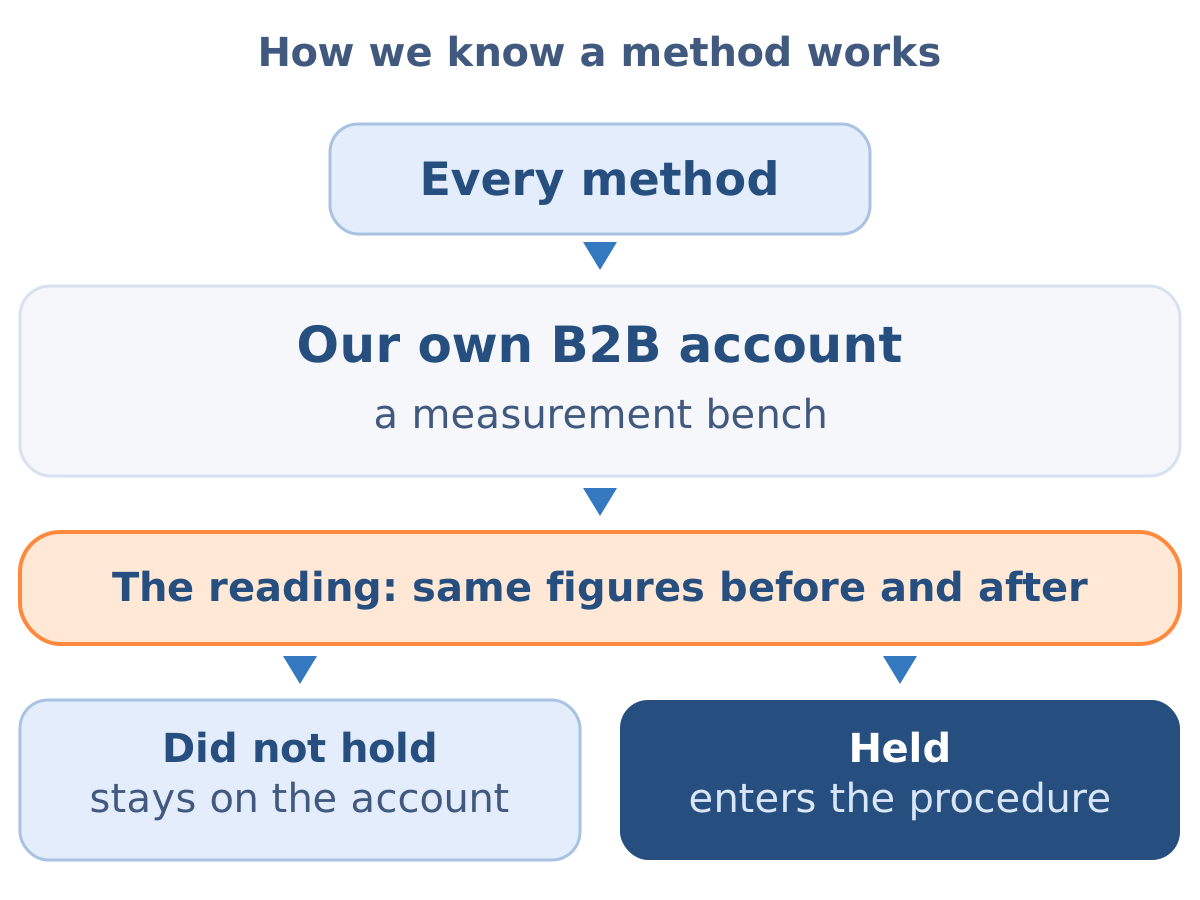
We run the method on our own account and leave it long enough to clear weekly noise. We compare only figures counted the same way before and after the change, and cross-check the reading in a second system. A full year is read nine months after it closed, so that orders from long buying cycles have had time to land in the count.
Implementation
A method that held its result goes into a procedure and reaches clients' companies together with its measurement definition — the instruction for checking that it worked for them. A method that did not hold its result stays in the lab as knowledge of what not to recommend.
The fourth move is the one a client pays for; the first three happen here, on our own account and at our own risk. The methods that come out of that loop are written up, channel by channel, in the lead generation guides.
Where drySEO lab numbers come from
Our published figures come from one real B2B account and always carry a denominator. Site-wide conversion in drySEO lab data is 0.8% — all site users divided by commercial enquiries in the CRM (0.7% once noise is filtered out). The familiar rule of thumb that “5% of visits turn into a lead” therefore sits 6–7 times above the measurement: it promises knowledge traffic the performance of a campaign landing page. At the other end of the funnel the direction reverses — enquiry-to-order conversion in drySEO lab data is 13.6% (range 11.6–15.0% depending on the denominator; orders divided by commercial enquiries). Both numbers make the same point: funnel stages are measured separately, each with its own denominator. How the price of one commercial enquiry follows from the same figures is shown on the services page.
Who runs drySEO
The lab is run by Jacek Kuczyński, founder of drySEO.
In marketing since 2004 and in SEO since 2011. Since 2008 I have led marketing at an export-driven B2B technology manufacturer, where I built the marketing department that earned the brand its global authority. From 2014 to 2021 I ran my own e-commerce business. drySEO has been my lab since 2013: here I test B2B lead generation methods — and since 2023, right from the start of the AI era, marketing with AI agents. Certified: Google Digital Marketing, Google Marketing Analytics, Semantic SEO.
Who drySEO works with
We work with B2B and B2G technology companies selling complex products in international markets, whose buyers start in search. The path from first query to order runs across months and across a buying committee, so content has to answer the committee's technical questions and measurement has to connect the Google visit with the order in the CRM. How such work looks across a full year of one programme is shown in the lead generation case study.