
B2B SEO is a channel whose product is the commercial enquiry. A company works on search visibility so that a message arrives from someone who went looking for a solution to their own problem. Everything that happens on the way — indexing, content structure, topical authority, testing — earns its place to the extent that it brings that one outcome closer. This page gathers the whole method in one place: from how a search engine works, through the semantic and content layers, to running the work and measuring the result.
What is B2B SEO?
B2B SEO is the work of making a search engine deliver commercial enquiries from people actively looking for a solution. The channel has three layers: the technical availability of the site, content that answers the market's real questions, and authority signals that lead an algorithm to treat the company as a credible source. In business-to-business markets this channel works more slowly than advertising and lasts longer than it, because topical coverage, once built, keeps working after the work stops.
How content reaches the results: crawling, indexing, ranking
A page reaches a search result in three stages, and any of them can stop it. Crawlers scan the web and follow links to discover a resource. Indexing organises what was collected, which depends on sound technical structure and on the site being available to robots. Ranking then orders results for a specific query, weighing hundreds of signals. Only the last of the three stages shows up in a rank report; the first two announce themselves as missing traffic. A page outside the index has a zero chance of producing a lead whatever the quality of its text, which is why technical hygiene — robots directives, a sitemap, load speed, JavaScript rendering, the mobile version — is the precondition for everything else.
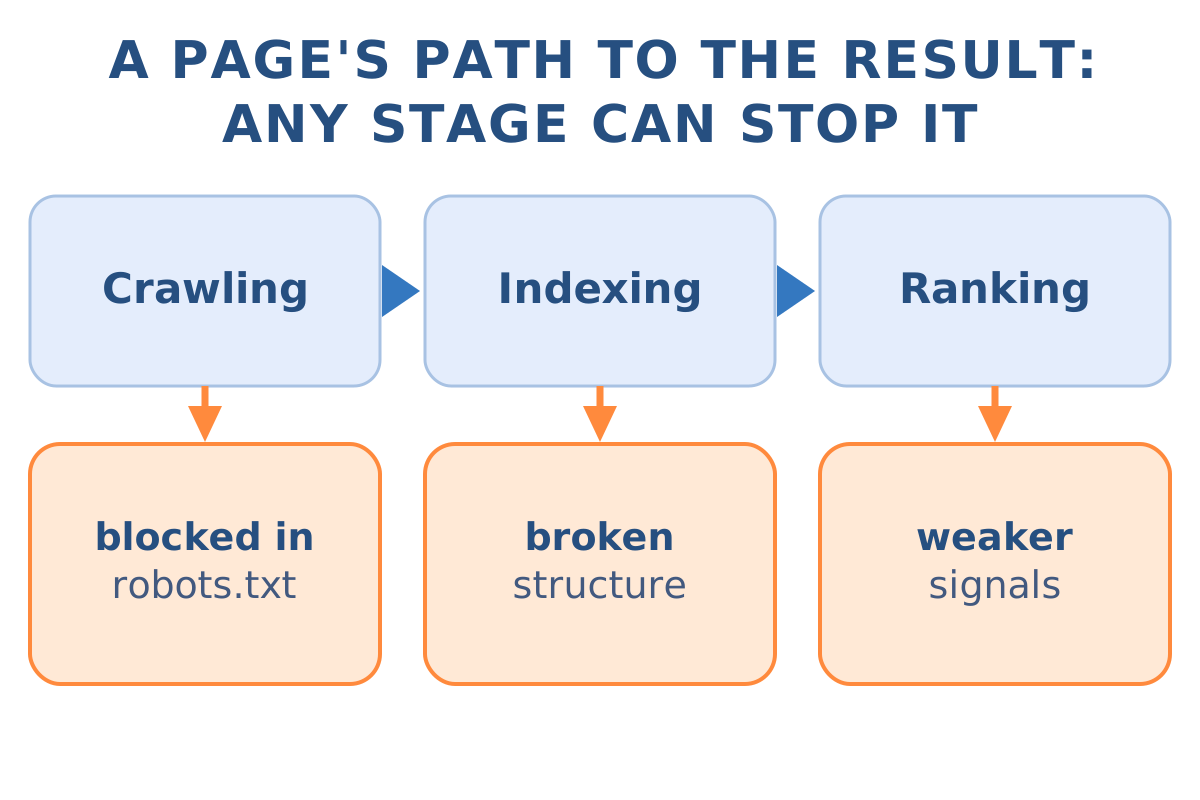
Indexation buys only the chance to be read; what that chance is finally worth is decided after the visit, in the CRM.
Why the channel is measured in commercial enquiries
Position is an intermediate stage; the commercial enquiry is the result. The orders of magnitude show why it pays to count all the way to the end:
- 0.8%
- of visits a knowledge-led site turns into commercial enquiries (denominator: all site users ÷ commercial enquiries in the CRM)
- 13.6%
- of those enquiries end in an order (denominator: orders ÷ commercial enquiries after noise removal)
Traffic counted only to the first threshold describes activity; both thresholds together describe revenue. Because commercial enquiries also arise outside search, the organic channel is worth viewing against the other sources of demand.
How does B2B SEO differ from B2C SEO?
B2B SEO works on smaller query volumes with far higher value per enquiry, and it addresses a decision made by several people over months rather than by one person in an afternoon. Four differences follow, and each changes what the work looks like.
Volume gives way to precision
A query with fifty searches a month, typed by engineers specifying equipment, can be worth more than a query with fifty thousand. Keyword selection in B2B is therefore a commercial exercise rather than a traffic exercise.
The audience is plural
The engineer evaluating the specification, the executive approving the budget and the team who will use the thing each search differently and need different pages. Coverage means covering a decision, not a keyword.
Content is judged by a professional
The reader knows the subject and detects unfamiliarity quickly, which raises the required standard and makes genuine expertise the cheapest available advantage.
The path is long and interrupted
The same decision-maker returns over weeks through different queries and devices, so the site has to work as a body of knowledge rather than as a single landing page.
The general mechanics of producing enquiries in this market, of which search is one channel, are set out in our guide to B2B lead generation.
What are the four types of SEO?
SEO is conventionally divided into four areas of work: technical SEO, on-page SEO, off-page SEO and local SEO. The division is a useful way to allocate effort, because the four fail differently and are fixed by different people.
Technical SEO
covers everything that determines whether a site can be crawled, rendered and indexed: site architecture, speed, mobile rendering, structured data, and the handling of duplicates and redirects. It is a precondition rather than a lever — its return is that the other three become possible.
On-page SEO
covers what a page says and how it is organised: the match between the page and the intent behind a query, heading structure, internal linking, and the completeness of the answer.
Off-page SEO
covers the signals that arrive from elsewhere, principally links and mentions from sources a search engine already trusts. In B2B these are earned largely through material worth citing.
Local SEO
covers appearing for queries with a geographic component, including the business profile that shows in map results. It matters for firms whose buyers are regional and for multi-site operations.
A fifth layer sits across all four and is treated separately below, because it is where B2B search is currently decided: the semantic layer, which governs whether a search engine understands what the company is an answer to.
Semantic SEO: describing a topic so it can be understood
Semantic SEO is optimisation for meaning. A topic is described through entities — things, people, concepts — and the relations between them, with the search phrase serving as one anchor of that description. For a lead channel this layer settles one question: whether a search engine offers the company as the answer at the moment a buyer describes their problem in their own words.
Topical authority holds the buyer to the end of the path
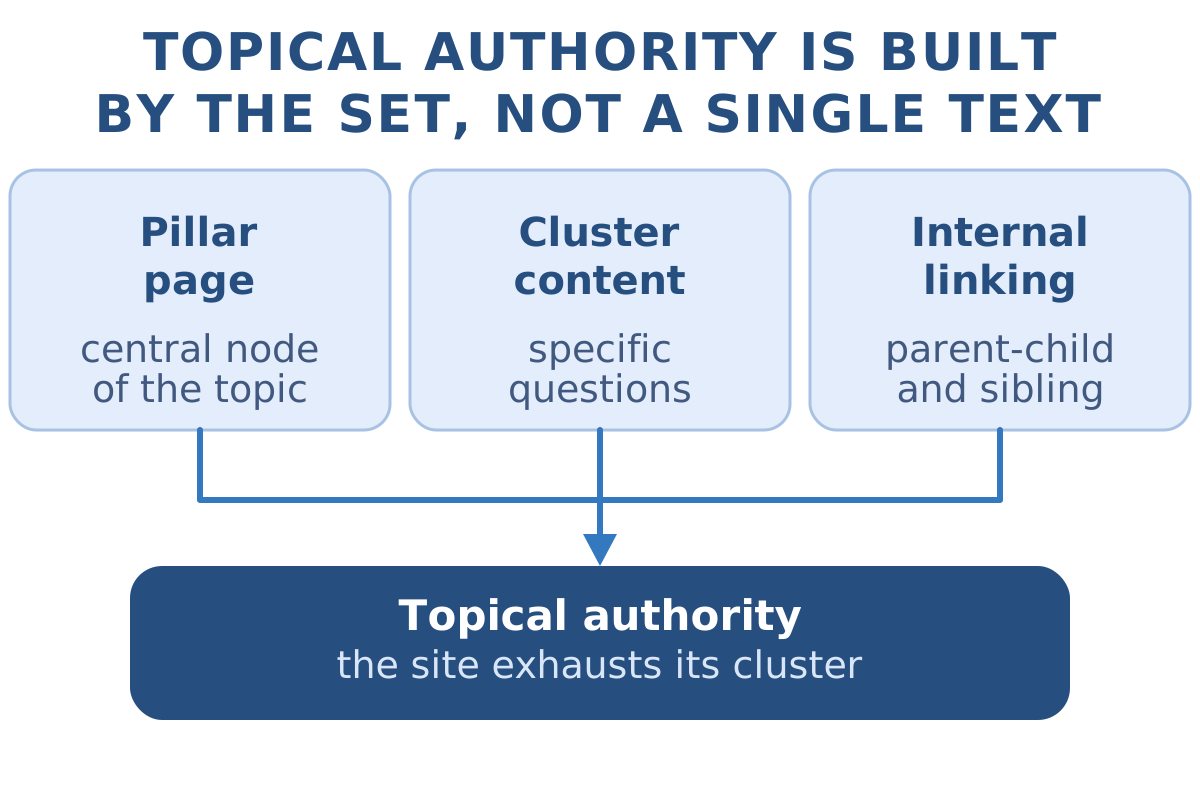
Topical authority is the degree to which a site exhausts its subject cluster. Three elements produce it: a pillar page as the central node of the topic, cluster content answering specific questions, and internal linking that mirrors the parent–child and sibling relations between them. The translation into leads is direct: a complete set of answers along the decision path keeps the buyer inside one site all the way to the form, and every missing link hands them to another source. The map of relations ages with the industry, so introducing entities that have entered circulation and retiring exhausted ones keeps that coverage alive.
Entities and subject–predicate–object triples place the firm in the knowledge graph
The subject–predicate–object triple is the smallest unit of semantic knowledge: a sentence built as [Subject A] [affects] [Object B] is mapped directly as a relation between entities. Declaring such connections explicitly — in the text and in structured data — seats a brand in the right place in an industry ontology, and an entity home, a single place on the web that defines the subject, keeps that definition consistent across every point of contact. The translation into leads: category queries go to entities a search engine can associate with the category, so a recognised identity is the condition of entering the contest for the contact at all.
Information gain and segmentation decide whether content is cited
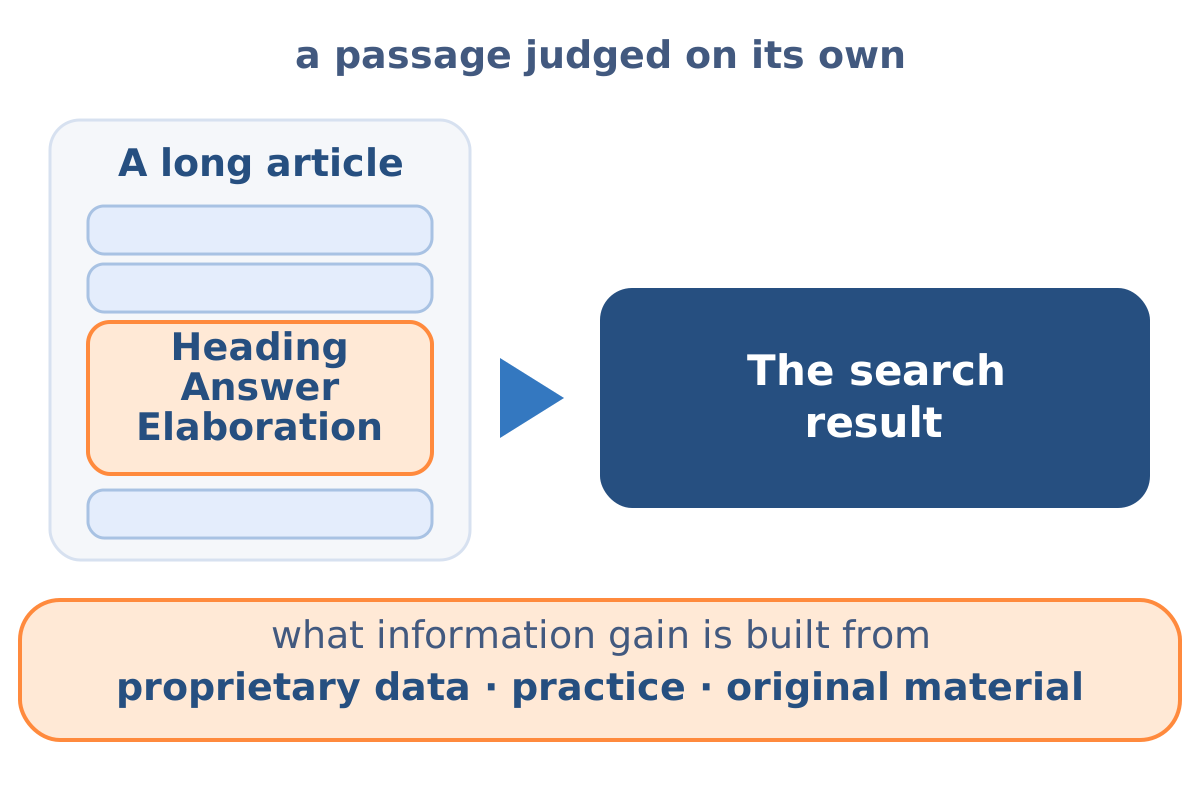
Information gain is the value a document adds to the existing stock of knowledge; a text repeating established findings becomes redundant content and stops working. Gain is built from proprietary data, a practitioner's perspective and original material, and segmentation makes it available to a machine: a paragraph designed as a self-contained unit — question, answer, evidence — can be excerpted without losing sense, and is therefore available to be chosen as a source. The translation into leads: a cited passage keeps a brand in circulation even for queries that end without a click.
In the laboratory this principle is the source of the whole measurement method: figures from our own implementations are published with their denominator, because the denominator is what makes a figure a measurement.
How this layer behaves in interfaces where a model composes the answer is settled in our AI SEO guide.
What role does content play in B2B SEO?
Content in B2B has one job: to carry a reader from recognising a problem to making contact. The purchase decision here spreads across weeks and several people, so the material is educational and commercial at the same time. Format follows stage — definitions and overviews at the entrance, criteria comparisons and case studies during evaluation, implementation specifics at the decision.
Experience is part of the content
Quality standards put first the evidence that the author has met the problem being described. The practical consequence: a named expert's byline, examples from real implementations, proprietary data from proprietary measurement. Content written from a practitioner's position carries decisions taken under specific constraints and their consequences, and that is the material a buyer returns to before sending an enquiry.
Paragraph engineering extracts value from long texts
An algorithm assesses individual passages independently of its assessment of the whole page. A long piece therefore gains when it is composed of sections each of which answers one question on its own: the answer in the first sentence, the elaboration beneath it, a precise heading above it. Value buried in the middle of an article then reaches the result as a ready answer.
Most of the market is not buying yet, and content is how you reach them
At any moment a small minority of a business market is actively buying and a large majority will buy later. This is the observation behind the 95/5 rule, a planning heuristic widely used in B2B marketing; the ratio in its name is a round approximation to think with, and each market has its own. Our own measurement speaks to the same structure from a different direction: a knowledge-led site converts 0.8% of all its users into commercial enquiries, 0.7% after noise removal (denominator: all site users ÷ commercial enquiries in the CRM; drySEO lab data). Most of the audience is doing exactly what a knowledge site is for, and content aimed only at the buying minority forfeits the rest.
A related heuristic, the rule of 7, holds that a buyer needs roughly seven contacts with a brand before acting. Lab practice puts the typical conversion of a new client after the fifth contact, with sequences running to twelve follow-ups — a directional figure from experience, distinct from the measured data on this page, which carries denominators. Either way the instruction for content is the same: a single article rarely closes the matter, and the path back has to be designed. The work of creating recognition among the majority who are still forming impressions is covered on the demand generation page.
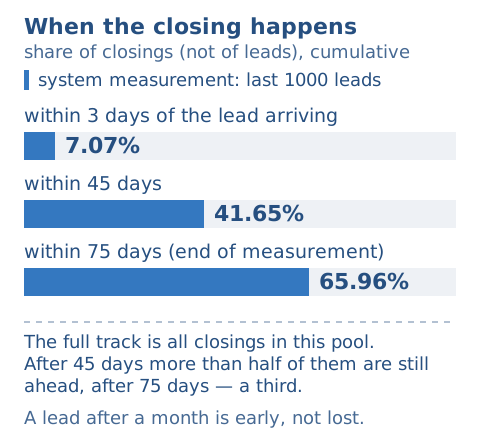
The decision window. The window is long: the chart in this section shows the distribution of closings measured on the lab's last thousand leads, with the denominator in its caption. The curve keeps rising through the whole measured period, so the path back has to be designed for months rather than for the week after the first visit — a reader who goes quiet a month after the first visit is usually early rather than lost.
How do you run a B2B SEO programme?
A B2B SEO programme is run as a project when the work spans many stages and several teams at once, and as a continuous operation once it is live. Site migration, technical audit, information architecture rebuilds and content refresh at scale all require sequence, schedule and a single owner of decisions. Without those, changes land in an arbitrary order and a drop in visibility is hard to attribute.
The stages that have to run in order
The process starts with understanding the business, the market and the competition, and ends with measurement and correction. The order matters: technical audit, query and entity research, a strategy with measurable goals, instrumentation, content production and optimisation, internal and external linking, monitoring, reporting. Content work done before indexing is repaired is wasted, because it produces material a robot will not see.
When to use sprints and when to use a linear plan
An iterative mode suits continuous operation: short cycles allow response to algorithm updates and to measurement without waiting for the quarter to end. A linear mode wins for one-off, high-risk operations such as a domain migration or a new URL structure, where each stage has to close before the next begins. Many teams combine both — a linear plan for critical operations, sprints for content and optimisation.
Foreign markets change the arithmetic
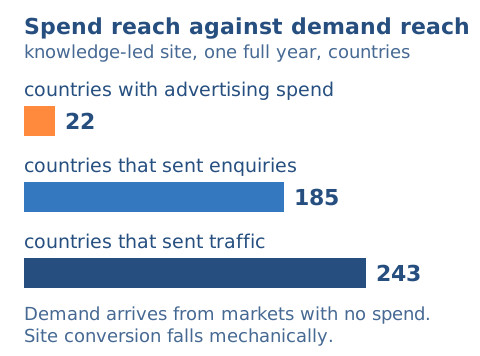
Working across several markets multiplies every element of the programme: content requires cultural adaptation, technical configuration covers language targeting and content distribution, and authority is built separately in each country. The mechanism is visible in measurement: organic search attracted traffic from 243 countries and commercial enquiries arrived from 185, while advertising reached 22 (denominator: countries with recorded traffic, with a commercial enquiry, and with advertising spend, in one year; drySEO lab data). A knowledge-led site therefore collects demand from markets carrying no advertising spend at all, and that is what should decide the order of expansion. The full mechanics of such a programme are developed in International SEO for Export Markets.
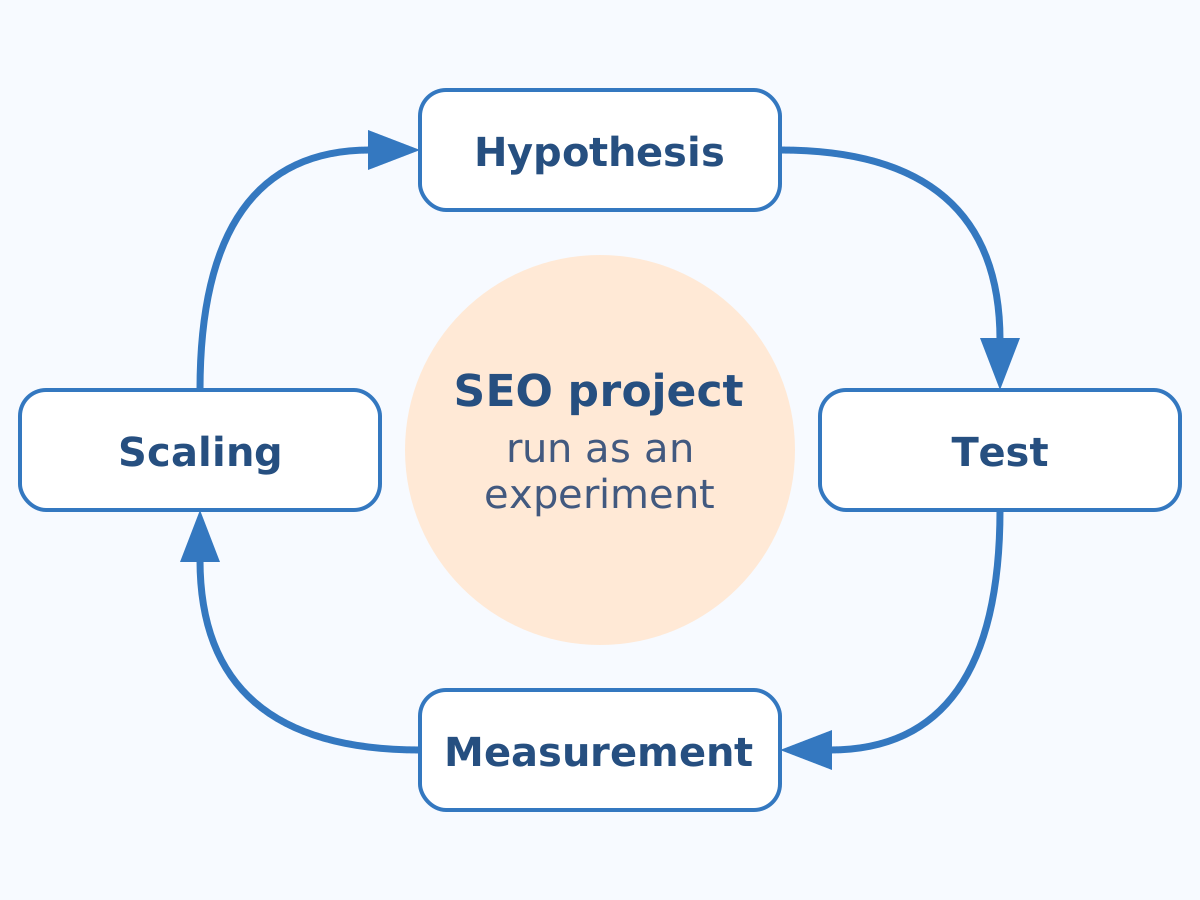
Experiment in SEO: hypothesis, measurement, scaling
An experiment in SEO is a cycle: analysis, ideas, prioritisation, test, scale. A team defines the one metric that matters for the cycle, generates hypotheses, ranks them by impact, confidence and ease of implementation, then tests on a slice of the site. A successful test extends to the whole; an unsuccessful one ends in a finding and returns to the queue. In a lead channel the metric of the cycle is the commercial enquiry, because a rise in clicks without a rise in enquiries leaves the company's result unchanged.
Scaling content from a database
Programmatic SEO builds many pages from a structured database and a template, covering attribute combinations that cannot be written by hand. The method works where each generated page answers a real query and supplies the data someone came for. The condition is quality and uniqueness control on every record, since thin pages burden the index and drag the whole site down.
The cost of scaling aggressively
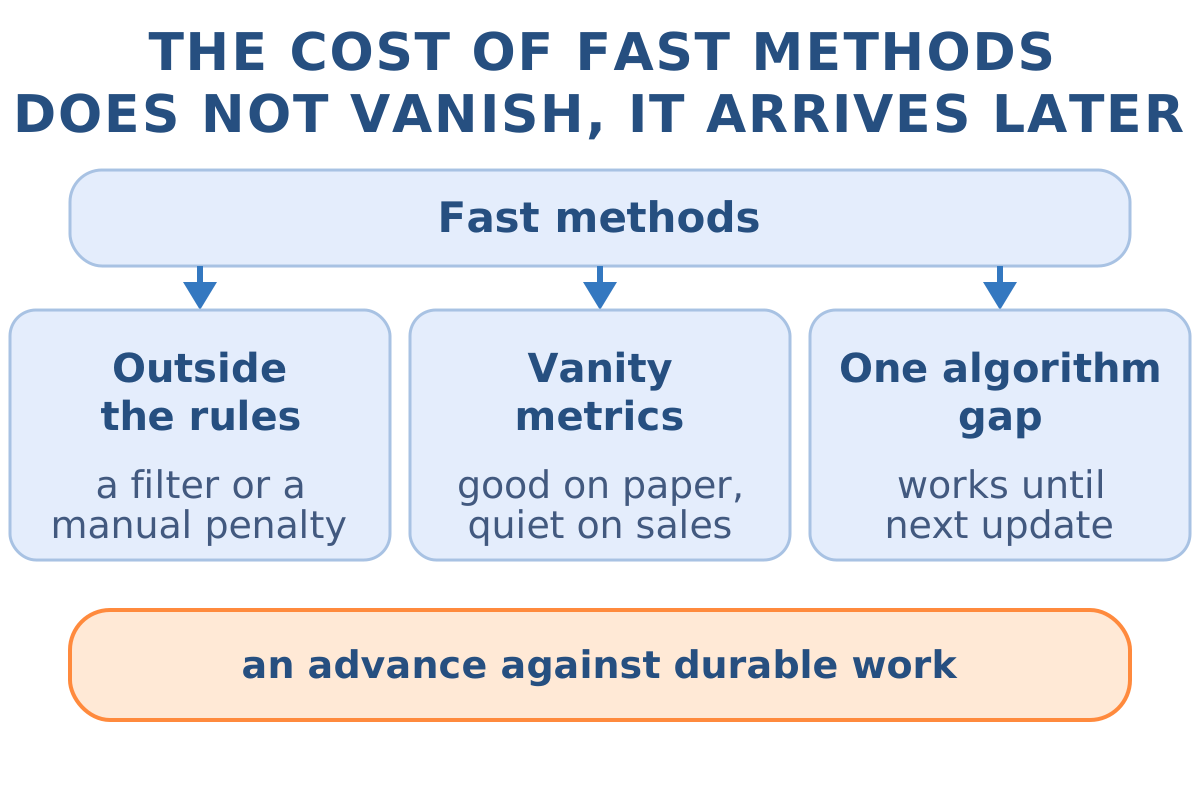
Fast methods carry three characteristic costs. Techniques outside search engine guidelines end in an algorithmic filter or a manual action and set the channel back by quarters. Vanity metrics — impressions, views, positions on queries with no purchase intent — look well in a report and stay silent about revenue. And a tactic built on a single gap in an algorithm stops working at the next update, so its result is best treated as an advance against durable work. Each of these costs arrives late, which is why the method still looks effective in the first quarterly report. How a search engine weighs the signals these tactics attempt to shortcut, and what follows for a safe pace of change, is explained in Google Algorithm: Ranking Mechanisms and SEO Strategies.
How do you measure B2B SEO ROI?
Measuring the channel starts with one decision: what counts as the result. For B2B the result is a commercial enquiry in the CRM, and everything before it — positions, traffic, visibility, engagement — is a leading indicator. The minimum set covers organic traffic, form enquiries with an attributed source, the share of qualified enquiries, and the close rate to order.
A tool's panel shows less than actually happened
Advertising and analytics systems report only what they can attribute. Comparing enquiries tagged with a campaign parameter in the CRM against the conversions in the panel gives a difference of 1.4–1.9×, always in the same direction: the panel sees fewer (denominator: campaign-parameter leads in the CRM ÷ panel conversions; a control from a third system agreed within 0.4 percentage points; drySEO lab data). The practical conclusion: treat a panel figure as a lower bound and take budget decisions after reconciling it with the sales system.
The ready-made funnel diverges from measurement
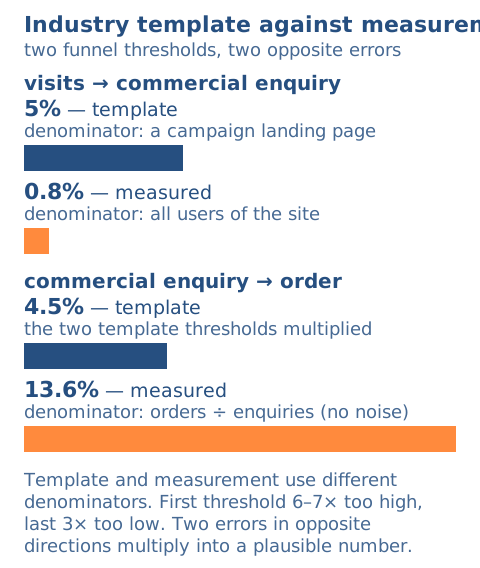
The popular composition of 5% site conversion, 30% qualification and 15% close falls apart at the first threshold when confronted with measurement. The first threshold is 6–7× too high against the measurement of a knowledge-led site (0.8% for all site users, 0.7% after noise removal; drySEO lab data), while the close rate turns out higher than the template assumes (13.6%; denominator: orders ÷ commercial enquiries after noise removal; drySEO lab data). Thresholds therefore have to be measured separately, each with its own denominator, because a five-percent conversion describes a campaign landing page while a knowledge site runs on its own figure. How to set up measurement, content and campaign so the numbers come from one source of truth is shown in the lead conversion guide.
How long does B2B SEO take to show results?
Months rather than weeks, and the stages arrive in a fixed order: indexation and visibility move first, traffic follows, and the commercial result arrives last, because the enquiry still has to pass through the buyer's own decision cycle afterwards.
How far that horizon runs, what moves it and the reference point measured in drySEO lab practice belong with the route from a search visit to an enquiry in the CRM. The scope of the work itself is described in our SEO and SEM services.
What are common B2B SEO mistakes?
Five mistakes account for most B2B SEO programmes that produce traffic and no enquiries, and each is diagnosable from the data a company already holds.
Chasing volume
Selecting queries by search volume imports a consumer habit into a market where the valuable queries are small. The correction is to rank queries by the value of the enquiry they could produce.
Writing for the search engine's vocabulary rather than the buyer's
Pages built around internal product names miss the problem-shaped language buyers actually type.
Covering a keyword instead of a decision
A single strong page leaves the adjacent questions, and therefore the buyer, to someone else.
Reporting leading indicators as results
A year of position improvements with a flat pipeline is a measurable event, and it is worth catching early by counting enquiries from the start.
Producing content before the site can be indexed
The most expensive sequencing error, because the work is invisible and the cause is not obvious for months.
Who runs the SEO channel in a company?
A named business role owns the channel. In a smaller organisation direction and budget sit with the owner or the person responsible for marketing, and execution goes to specialists. In a larger one, operational strategy is led by an SEO lead or the marketing team, while decisions on annual budget and alignment with company goals are taken at board level. The condition for effectiveness is a standing channel of communication between marketing and the technical team, because most changes require implementation in code.
Collecting contact and analytics data is subject to data protection law. A site needs a working consent mechanism, a clear privacy policy and a way to honour user rights. Consents are worth setting up before measurement is switched on, because only then is the data on lead sources complete and usable in decisions.
FAQ
What is the difference between SEO and SEM?
SEO covers the work that builds visibility in organic results. SEM is the wider term and covers both SEO and paid campaigns in the search engine. Both channels lead to the same form, so they are compared on the cost and the quality of the commercial enquiry they produce.
Is SEO still worth doing when an AI assistant will show the answer?
Yes, on condition that the text contributes something absent from a model's corpus: proprietary data with a denominator, experience from implementations, original material. A short synthesis in a search interface closes simple questions, while high-value decisions require material that exceeds such a synthesis. Content structured for citation also serves as a source for a generated answer, which keeps a brand in circulation for queries that end without a click.
How much content does a B2B company need?
Enough to cover the decision rather than a target number of articles. The working test is whether a buyer can answer every question their purchase requires without leaving the site. That standard is met by a coverage map built from the questions the market actually asks, and it is reached at very different page counts in different industries.