
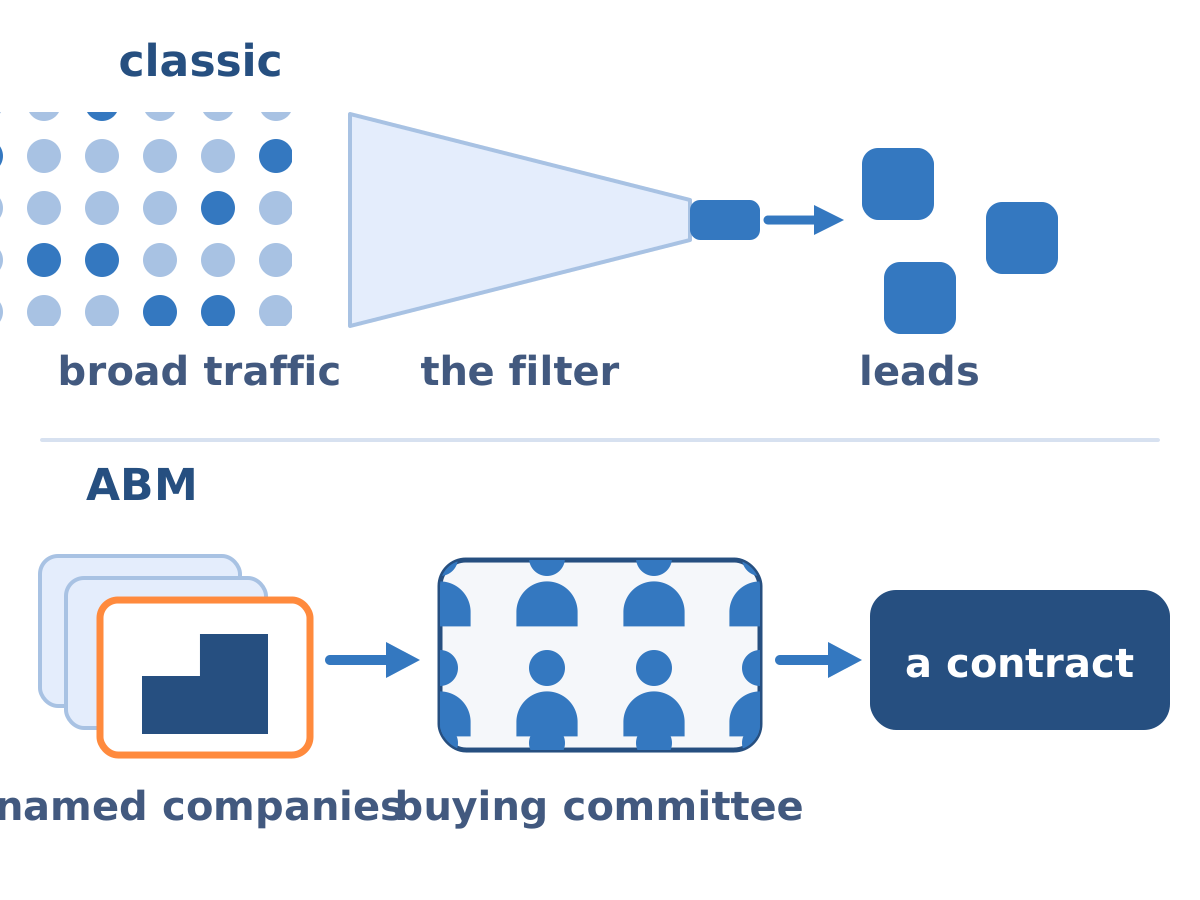
Account-based marketing is a B2B strategy that inverts the usual order: instead of attracting broad traffic and filtering it down to leads, marketing and sales first choose named companies with the highest potential, then build reach into the people who decide inside them. It is the other pole of the same process as B2B lead generation — precision instead of volume. This guide covers when ABM pays, the three levels it scales across, how to implement it, what it costs in structure, and how to measure it.
What is account-based marketing?
It is a strategy in which the unit of work is an account — a specific, named company — rather than an anonymous lead. Sales and marketing jointly select a target account list, map each account's buying committee, and run personalized communication to every role on it. The familiar image: classic lead generation fishes with a net and sorts the catch, while ABM hunts named targets.
One distinction decides whether a programme is real. ABM is a business strategy, not a campaign type. It requires a change in how success is measured (accounts instead of leads), in how budget is allocated (deeper into fewer companies), and in how sales and marketing work together. An ad campaign aimed at “large companies” is targeting, not ABM.
When does ABM make sense?
When at least two of four conditions hold: high value per transaction, so personalization pays back from a single contract; a countable market, meaning tens or low hundreds of companies that could realistically buy; a buying decision made by a committee; and a long sales cycle. Under those conditions broad marketing wastes budget on audiences that will never buy, and each of the few right accounts deserves its own approach.
ABM does not pay for mass-market products with thin margins and a wide market. There, the cost of personalization exceeds the value of a transaction, and a classic funnel with good qualification works more cheaply. That is a judgement about your economics rather than about the method, and it is worth making before the first account list exists.
What are the types of account-based marketing?
Account-based marketing has three types, and most companies run a mix of them.
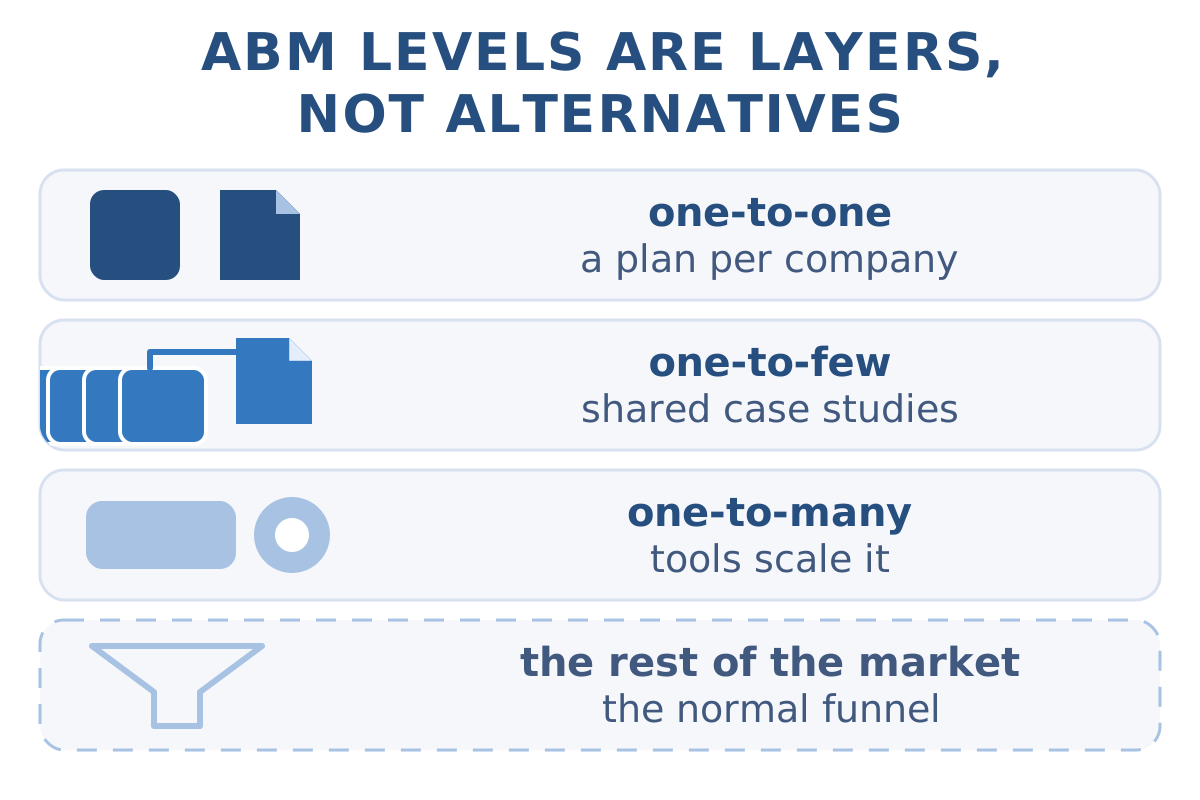
An account sits on one level at a time, and moving it up is a decision about money rather than about method.
One-to-one
A handful of strategic accounts with full personalization — separate content and a separate plan per company. The most expensive and the most effective.
One-to-few
Clusters of similar accounts, usually by industry, personalized at cluster level with shared case studies and campaigns.
One-to-many
Hundreds of accounts, with personalization scaled by tooling — dynamic content and advertising aimed at company lists. This is the boundary beyond which ABM starts to resemble well-targeted classic marketing.
How do you implement an ABM strategy?
Five steps:
- Define the ideal customer profile. Built from data about your most profitable current customers: industry, size, technologies, patterns of success. A profile of a company, not of a person.
- Build the target account list. Named companies matching the ICP, verified for potential and health. The list is jointly owned by sales and marketing, and it is deliberately short. Each account is assigned its service level — one-to-one, one-to-few or one-to-many — immediately.
- Map each account's buying committee. Who decides, who evaluates, who uses, who can block. The role profiles come from B2B Buyer Persona, applied per company instead of per market.
- Prepare personalized content and channels. Materials addressing this company's problem and this role's concern: case studies from their industry, tailored offers, sometimes pages built for one account. Reach combines LinkedIn Lead Generation, account-targeted advertising, Cold Email Lead Generation, and personalized page variants for companies on the list.
- Run the accounts jointly and measure per account. One plan covering who reaches which role, with what, and when — and progress judged by account engagement rather than by lead count.
How are ABM personas different from buyer personas?
A buyer persona describes a representative of a market segment; an ABM persona describes a role inside a named company you have already chosen. The skeleton is the same — goals, pain points, objections, decision criteria — and three things change:
The context is specific
Not “an operations director in manufacturing”, but the operations director at this company, with its systems, its recent reorganisation and its stated priorities.
The set is defined by the committee, not by volume
You build profiles for the roles that appear on this account's committee, however unusual the mix.
They expire faster
People change jobs, and a committee map is out of date within months, so the list needs continuous hygiene rather than a one-off research project.
The audience definition underneath both is the same one: B2B Target Audience.
How does ABM differ from inbound marketing and lead generation?
Inbound attracts: content and search bring in interested people, and qualification filters out the ones who do not fit, so you do not know in advance who arrives. ABM selects: it starts from named companies and builds reach to them rather than waiting for a visit.
They are complementary rather than competing. Inbound serves the whole market and builds the authority ABM then borrows when it reaches accounts on the list — a cold approach from a company whose material the committee already reads is a different conversation entirely. ABM closes the companies that are too valuable to wait for.
The choice between them comes down to one question: are you optimising for activity or for impact? With a countable market and large contracts, impact wins. With a wide market and modest deal sizes, activity is the cheaper path to the same revenue.
How much does ABM cost, and what is its ROI?
The cost is driven by the length of the list multiplied by the depth of personalization, not by media spend — which is why a long list is the expensive mistake rather than the ambitious one. Doubling the account list roughly doubles the content and research work, while doubling the personalization depth does the same, so the two multiply.
The return is computed differently from classic lead generation, and this is the part most programmes get wrong. ABM is judged per contract, not per lead, because the whole point is that few accounts produce large deals. The mechanism to hold onto: the value of an account is the size of the order it would place multiplied by the probability of closing it, and that product is what decides how much personalization an account can justify. An account whose realistic contract value cannot carry one-to-one treatment belongs in the one-to-few tier — that decision, made honestly, is most of the cost control available.
Two practical consequences follow. Measure over quarters rather than months, since the cycles that make ABM worthwhile are the same cycles that delay its evidence. And compute the return on the accounts you worked, with the denominator stated — the counting discipline that makes such comparisons meaningful is set out in the metrics guide.
What are the common challenges in ABM, and how do you overcome them?
Three challenges recur in every implementation, each with a known remedy:
Content production becomes the bottleneck
Per-account personalization outruns any team. The remedy is layering: a shared core of content with a personalized ending per industry and role, rather than bespoke material end to end.
Data ages
Committee maps decay within months as people move. The remedy is continuous hygiene — a standing review slot rather than a research project.
Attribution is hard
With a cycle of many months, no single action can be credited with the outcome. The remedy is measuring account engagement over time instead of hunting for the source of a contract.
Four mistakes come from practice rather than from theory. A list that is too long — “ABM across 500 companies” is ordinary marketing with a new name. Cosmetic personalization, where a company name is dropped into a template. Sales outside the process, so that marketing warms accounts nobody then calls. And judging the programme after one quarter, which is too early for the cycles involved. Coordinating the sequences without multiplying the manual work is what marketing automation is for, particularly its account-level rollup.
How do you measure account-based marketing?
Not by lead count — that metric belongs to a different model. ABM is measured on accounts, in this order:
- Account engagement — the share of accounts on the list where the right people have interacted with you.
- Accounts with an open opportunity — pipeline expressed in companies rather than in contacts.
- Value and velocity of those opportunities.
- Average contract value, which should rise from account selection alone.
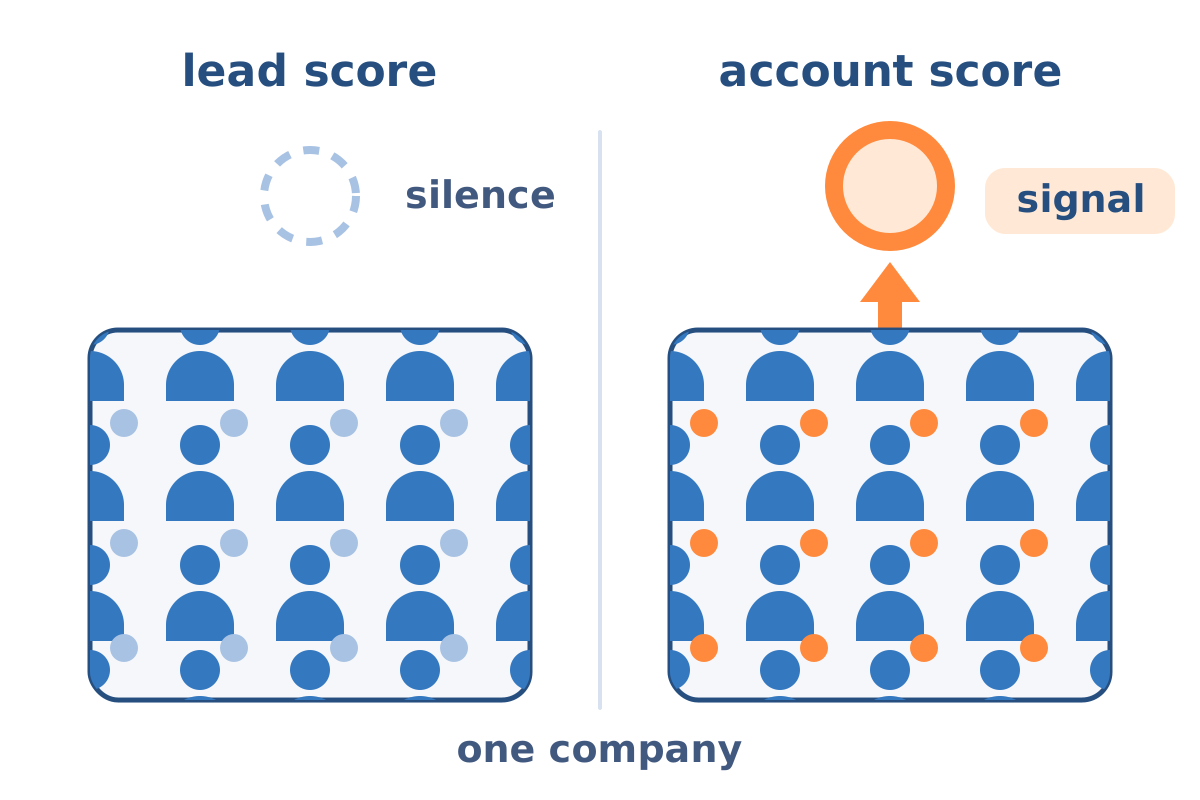
Scoring runs at account level: points accumulate across everyone on the committee together, rather than per individual lead. A single lead score cannot see five people from one company reading quietly, which is exactly the signal ABM exists to catch. The horizon for judgement is a quarter or longer.
Frequently asked questions about account-based marketing
Does ABM work in a small company?
Often it is the natural fit, since a small B2B company usually lives off a dozen or so key customers already. The minimal version needs no platform: a hand-built list of twenty to thirty accounts, decision-maker maps in a spreadsheet, LinkedIn and email as channels, and the CRM as the backbone.
How many accounts should you start with?
As many as the team can serve with genuine personalization — usually ten to thirty at the one-to-one and one-to-few levels. Deep reach into twenty companies beats shallow reach into two hundred, and the list can grow once the process is steady.
How do you start an ABM pilot?
Pick one segment, one service level and a short list, then run a full quarter before judging anything. Success in a pilot is measured by account engagement — are the right people interacting — rather than by closed deals, which arrive later.
What is intent data, and do you need it?
Intent data are signals that a company is actively researching a solution: rising consumption of industry content, supplier comparisons, activity from particular roles. They help rank accounts by readiness. Treat them soberly — signals contain noise, and good data costs money. At smaller scale, watching accounts on LinkedIn and in your own analytics fills the same role.
Where does the conversion actually happen?
On a page built for it, exactly as in every other channel. Account-targeted advertising and outreach create the visit; the page does the closing, and how that page is judged is covered in the conversion guide.