
Lead qualification is the assessment of which acquired contacts have a real chance of becoming customers, and in what order the sales team should work on them. It acts as a filter: it separates genuine sales opportunities from noise — students, competitors, companies with no budget — and sets the priority of every conversation that follows.
In B2B, where a single sales conversation costs hours of preparation, qualification decides the efficiency of the whole sales process. This page covers the qualification process step by step, the frameworks that structure it, how lead scoring automates part of it, and how to tell whether the filter is calibrated.
What is a qualified lead?
A qualified lead is a contact that has been checked against written criteria and found to fit the customer profile closely enough to justify sales time. The output of qualification is a status, and in practice two statuses carry most of the work:
Marketing qualified lead (MQL)
fits the customer profile and has shown interest by downloading material, attending a webinar or returning to the site. Sales readiness is still ahead of it.
Sales qualified lead (SQL)
a verified contact with a confirmed need, budget and decision-making authority, handed over for direct conversation.
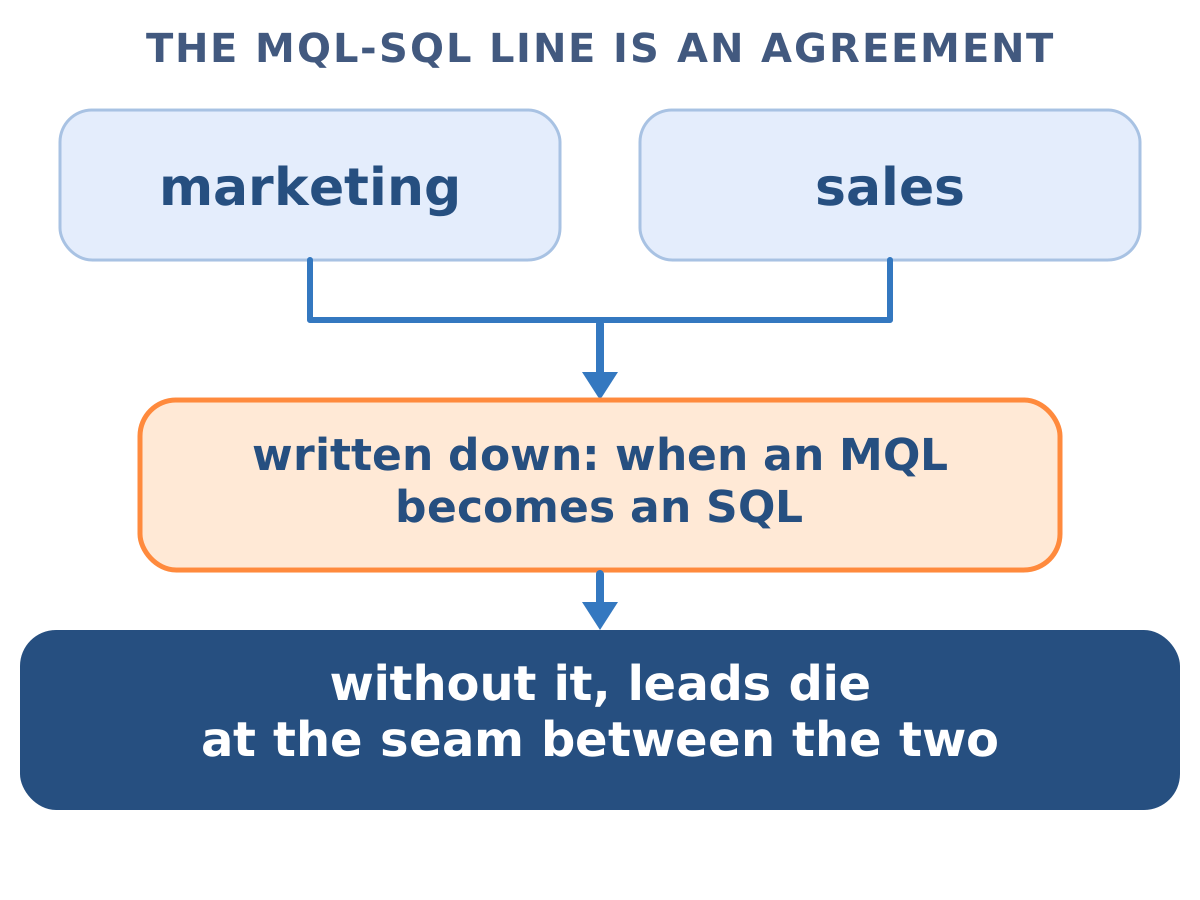
The boundary between the two is an agreement between marketing and sales rather than a property of the lead. Where that agreement is written down, a dispute about lead quality becomes a question with an answer; where it is assumed, both departments measure different things and the argument recurs every quarter.
A third status appears in businesses that let a buyer try the product: a product qualified lead (PQL), which signals intent through usage rather than through marketing engagement, and is generally the most reliable intent signal available.
What are the steps in the lead qualification process?
The qualification process runs in five steps, and the fifth is the one that keeps the other four accurate.
- Set the criteria. The starting point is the ideal customer profile: which company and role characteristics indicate fit, and which disqualify a contact immediately. Both halves matter, and the second is the one more often left blank.
- Collect the data. Some comes from the form — role, company, stated need. Some comes from behaviour on the site: which material is read, whether the visitor returns. The rest comes from a first call or email.
- Assess against a model. BANT, MEDDIC or a documented set of questions of your own. What matters is that every salesperson assesses the same way and that the result is recorded in the CRM.
- Hand qualified leads to sales. A lead that clears the threshold reaches a salesperson with everything already gathered, and the speed of that handover shows up directly in the close rate.
- Close the feedback loop. Sales rates the quality of what it received, and marketing adjusts the criteria. Criteria set once age silently; a regular review is what keeps the filter in calibration.
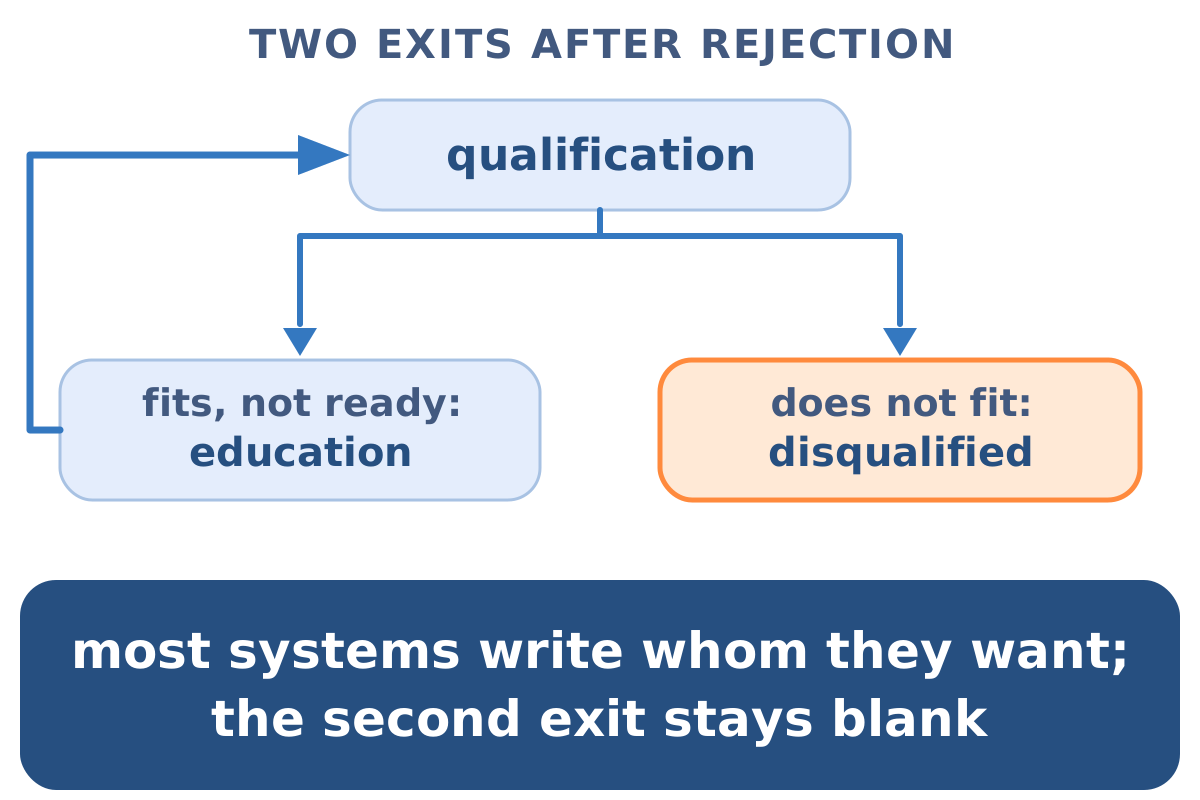
A lead rejected at qualification stays in the system if it fits the profile — it returns to an education programme and matures at its own pace, as covered on Lead Nurturing.
What are common lead qualification frameworks?
The simplest framework, and often the sufficient one, is BANT — four criteria that settle whether an opportunity is real.
Budget
Does the company have funds allocated to solving this problem?
Authority
Is this the person who decides, or someone who will first have to persuade a decision-maker?
Need
Does a real problem exist that the product solves, and does the buyer recognise it as a problem?
Timeline
When is implementation planned? A project scheduled for “someday” is a research conversation.
In complex sales, where a purchasing committee decides, BANT can run shallow. MEDDIC goes deeper by identifying the measurable effect of implementation and the internal advocate who will carry the decision inside the buying organisation. CHAMP reverses the order, starting from the buyer's challenges and reaching budget last, which suits markets where budget is assembled once a problem has been accepted.
The choice matters less than consistency. A framework applied the same way by everyone produces a comparable record; several frameworks applied informally produce a pipeline whose statuses mean something different for each salesperson.
What questions should you ask to qualify a lead?
Five questions settle most B2B qualifications, whichever framework supplies the labels:
- What problem is the company trying to solve, and what happens if it stays unsolved?
- Who decides on a purchase of this size, and who else signs off?
- What budget has been allocated to this initiative?
- By when does the solution need to be working?
- What has been tried before, and what happened?
The last one earns its place. A buyer who has already tried something reveals the evaluation criteria, the internal history and the objection that will surface later — usually in a single answer, and usually before any pricing conversation.
What is the difference between lead qualification and lead scoring?
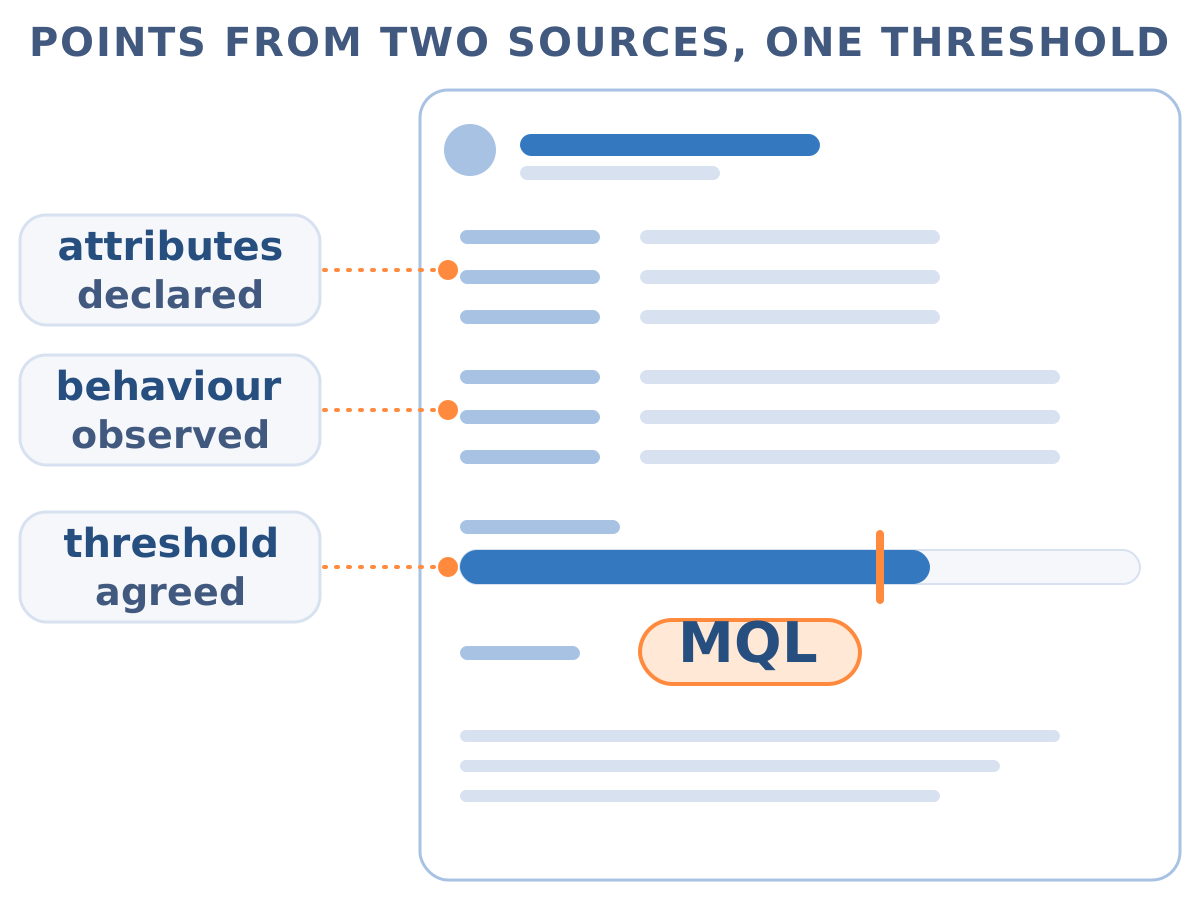
Lead scoring is the automated, points-based form of qualification: a system awards points and changes a lead's status once a threshold is crossed. Qualification is the wider judgement, including the conversation that scoring cannot hold.
Points come from two sources:
- Attributes (declared data). Role, sector, company size — fit against the customer profile. An operations director at a manufacturing company scores higher than a student.
- Behaviour. A visit to a pricing page, a case-study download, webinar attendance — signals of rising purchase intent. A visit to the careers page or an email address on a competitor's domain scores negative.
Score decay completes the model: a lead inactive for a defined period loses points, so salespeople see the contacts engaged now rather than the ones engaged last year. The threshold at which a lead becomes an MQL is set jointly by marketing and sales — set low it floods the sales team, set high it drains the funnel.
Predictive scoring, where a model learns from the history of won and lost deals and finds the patterns itself, becomes worthwhile at high lead volumes. On a small sample, hand-written rules perform comparably and have the advantage of being legible when someone asks why a lead was promoted.
How do you measure whether qualification is working?
Measure qualification at the seam between departments, with three figures that each expose a different failure.
Close rate from qualified lead to order. On the drySEO laboratory's own B2B account this comes out at 13.6% — orders divided by commercial enquiries excluding noise, range 11.6–15.0% depending on the denominator, measured from full-year exports (drySEO lab data). A rate materially below your own established baseline indicates a threshold set too loose.
One caveat belongs beside that figure, because it changes how it should be used. Close rate varies by market more than most calculations assume: alongside the measurement stands a directional observation from the laboratory's own practice that on markets furthest from a client's core business the same ratio can run at roughly 5–6% (drySEO lab data, directional from practice, not an export — same denominator). The distance of about 2.5× means a qualification threshold calibrated on a home market will misjudge a distant one, and that market is a stronger variable here than sector.
Share of MQLs rejected by sales. When salespeople return a large and rising fraction, the marketing criteria have drifted from what closes. This is the fastest signal that the feedback loop has stopped running.
Time from qualification to first sales contact. A lead cools quickly, and measuring the interval is the cheapest available optimisation of the whole process.
How can AI and automation help with lead qualification?
Automation handles qualification reliably up to MQL and supports the human judgement beyond it.
Up to MQL the work is rule-following at volume: award points for attributes and behaviour, apply decay, change status at the threshold, route the lead to an owner and timestamp the handover. Machine learning extends this by finding which behaviours actually correlate with a closed sale in your own history, which tends to surface signals that hand-written rules rank too low — repeat visits to technical documentation being the common example in B2B.
Verification to SQL rewards a conversation. Confirming budget and authority means asking, and the quality of that exchange carries into the close rate. The productive division is therefore to let automation decide what reaches a salesperson and how fast, and let the salesperson decide what it is worth.
What happens to a lead that fails qualification?
A lead that fits the profile but is not yet ready goes into an education programme and returns when the need matures. A lead that falls outside the profile is disqualified permanently, and recording that decision keeps the pipeline statistics meaningful.
The missing half of most qualification systems is the disqualification procedure. Companies define who they want in detail and leave who they decline undefined, so contacts accumulate in the funnel where they depress every ratio measured on it. Writing the exclusion criteria down is what converts a filter from an intention into a mechanism.
What are the most common mistakes in lead qualification?
Three mistakes account for most miscalibrated filters.
Passing everything through
Out of concern about losing an opportunity, every contact is forwarded, and the process stops filtering. The cost lands on the most expensive stage: sales conversations.
Criteria written once and left alone
Without the feedback loop, criteria drift from the market within months while continuing to look authoritative in the CRM.
Qualifying on activity alone
Someone who reads everything may have neither budget nor authority. High engagement combined with weak profile fit describes a competitor more often than a customer, which is the reason attribute scoring and behavioural scoring belong in the same model.
Frequently asked questions
Does every lead need qualifying?
Yes, with the depth varying. A referral from an existing customer can be qualified in one conversation; a form submission needs the full path, because nothing about its intent is known. Skipping qualification moves its cost to the sales conversation rather than saving it.
Can lead qualification be automated?
To MQL, yes — scoring in a CRM or automation tool awards points and changes statuses without human involvement. Verification to SQL rewards a call, since budget and authority are confirmed by asking.
Who owns qualification, marketing or sales?
Both, at different stages: marketing qualifies to MQL on data and behaviour, sales verifies to SQL in conversation. The condition is a shared written agreement covering what a qualified lead is, how many marketing supplies and how fast sales responds.
Is qualification the same as prospecting?
Prospecting finds contacts; qualification sorts the ones already acquired. They are adjacent and easy to blur, and keeping them separate matters for measurement — prospecting is judged on volume and fit, qualification on what share of its output closes.
How often should qualification criteria be reviewed?
On the same cadence as the sales pipeline review, with a full recalibration whenever the close rate moves materially or a new market is entered. The market-driven variation described above is the practical reason for the second trigger.