
Lead nurturing is the process of maturing a lead: systematically supplying useful material to contacts who have left their details and are still some way from a purchase. It is the middle link of the chain, and it works on contacts the company has already paid to acquire.
The reason it matters in B2B is arithmetic. Most acquired contacts answer the first approach with some version of “later”, and the value of that answer depends entirely on whether anyone stays in touch through the interval. This page covers the mechanics of nurturing, how to design a campaign, the types of campaign worth running, and the metrics that say whether the paths are maturing anyone.
What does lead nurturing mean?
Lead nurturing means building a relationship with a qualified but immature contact by answering the questions that contact is currently asking, so the company remains the first choice once the need matures into a decision.
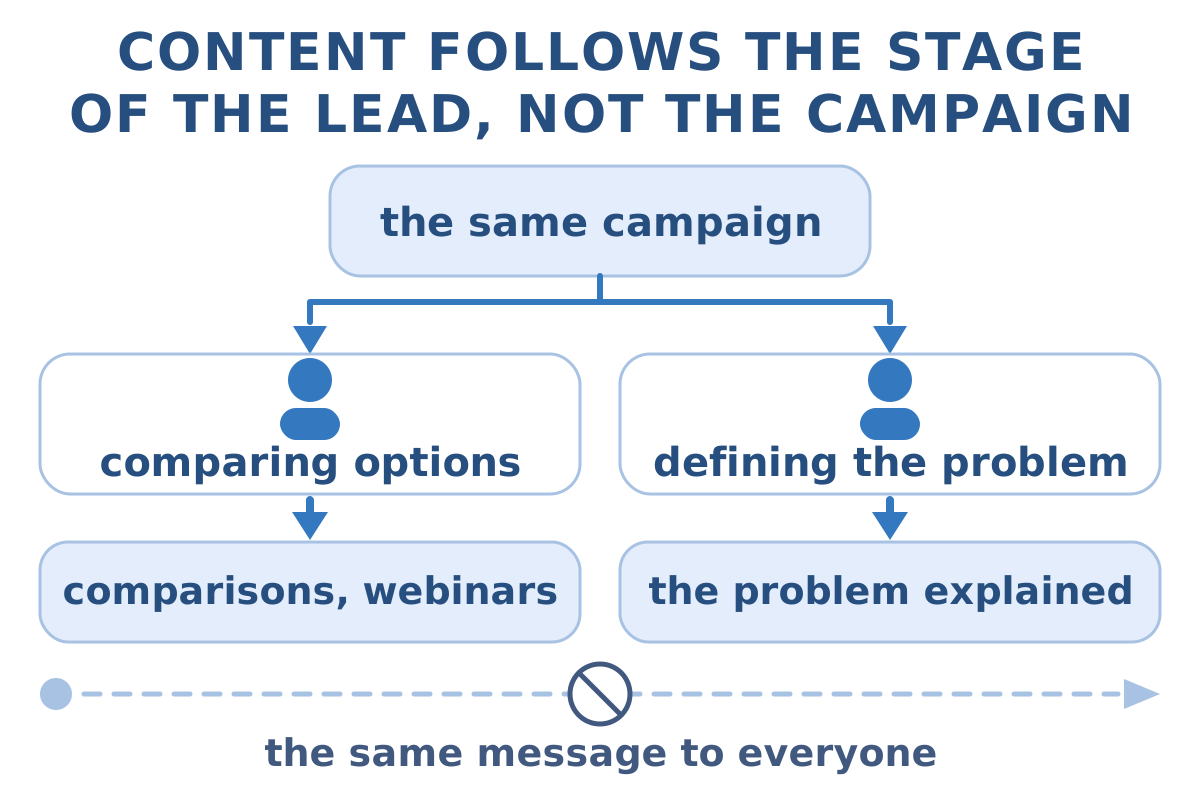
The goal is double: retain a contact already paid for, and shorten the route to purchase through education. What separates it from ordinary email marketing is depth. A single message broadcast to a whole base is a campaign; nurturing is a set of paths matched to stage and behaviour, tied to lead statuses in the CRM. Two leads from the same campaign can receive entirely different material, because one is reading comparisons while the other is still defining the problem.
How long does lead nurturing take in B2B?
Nurturing lasts as long as the buyer's purchase cycle, and in B2B a substantial share of that cycle sits beyond the first month.
The values stand on the chart in this section, with their denominator: a measurement on the lab's last thousand leads, counted as a share of closings, not of leads. What the curve gives a nurturing programme is its planning horizon — a month's enquiries keep closing through at least the next two months, and the measurement ends before the curve has flattened. The practical reading is that a lead written off after a month is usually a lead that was early rather than lost, and the longer part of that distribution is exactly what a nurturing programme exists to capture.
The same practice gives the cadence a shape. Conversion of a new customer most often follows around the fifth contact, and sometimes takes as many as twelve follow-ups (drySEO lab data, directional from practice rather than an export). At that count, follow-up has to be automated to happen at all — a sequence of five to twelve touches per lead, held across months and across a growing base, is beyond what manual effort sustains. That single observation is the strongest practical argument for marketing automation in a B2B funnel.
Paths are therefore designed without an end date. A lead leaves nurturing by crossing a readiness threshold or an expiry threshold, and the sequence running out is a design fault rather than an exit.
What do email and social actually do during that interval?
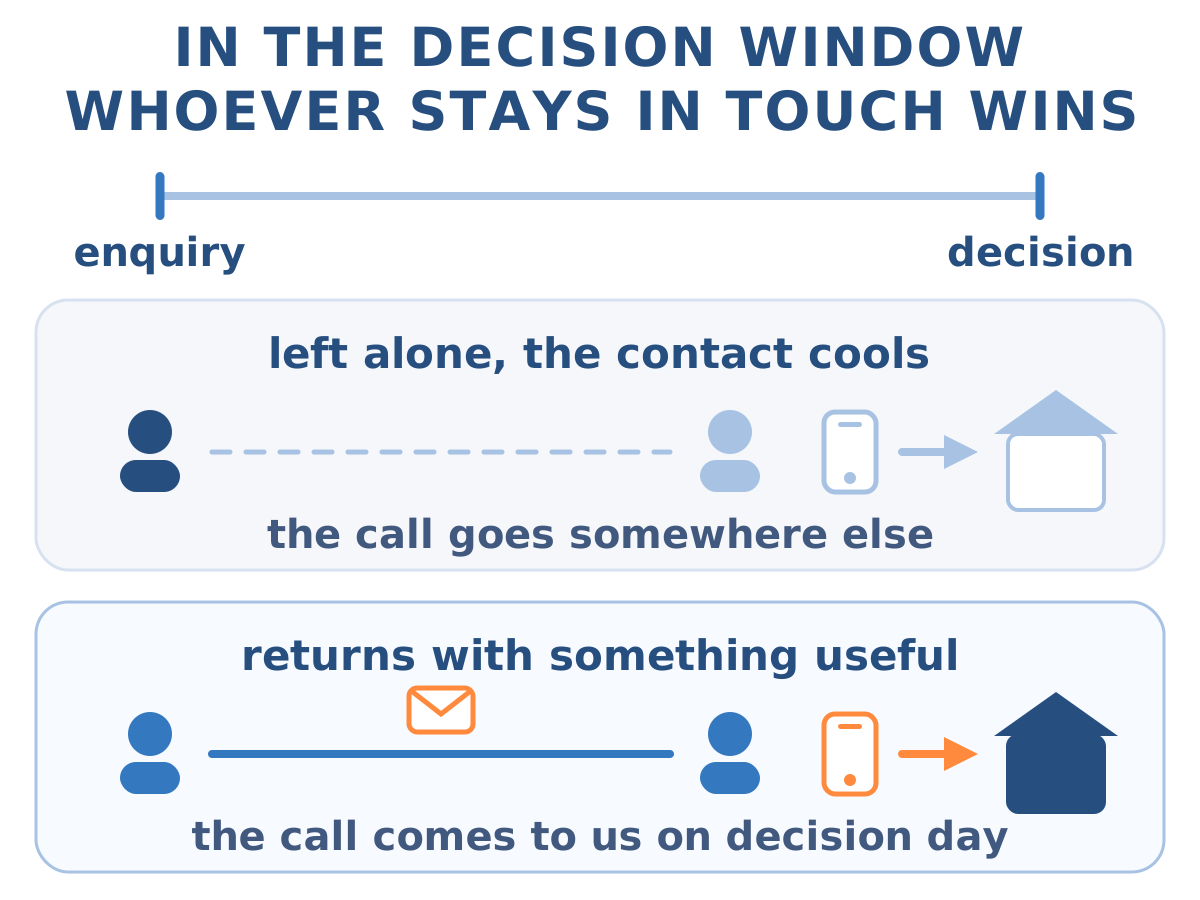
They hold the lead's attention while the decision is being made, which is a different job from producing the enquiry in the first place.
From the laboratory's practice, the role of both email and social in a B2B cycle is to warm a lead through the window between the enquiry and the decision (drySEO lab data, directional from practice rather than an export). When that window runs for months, a contact left alone cools, and the supplier who returns during the interval with something useful is the one who gets the call on the day the budget is signed.
This is where a common reporting error starts. Judging a newsletter or a company profile by how many enquiries arrived through it this month measures a channel against a job it does not hold: it prices time-keeping as if it were demand generation. Demand enters elsewhere, the conversion happens on a destination page, and what these channels decide is how much of the pipeline survives long enough to reach that page. Set the denominators accordingly — the metrics guide covers how.
How does the lead nurturing process work?
The mechanics form a loop with four elements, and the loop is what turns waiting for a buyer's decision into something measurable.
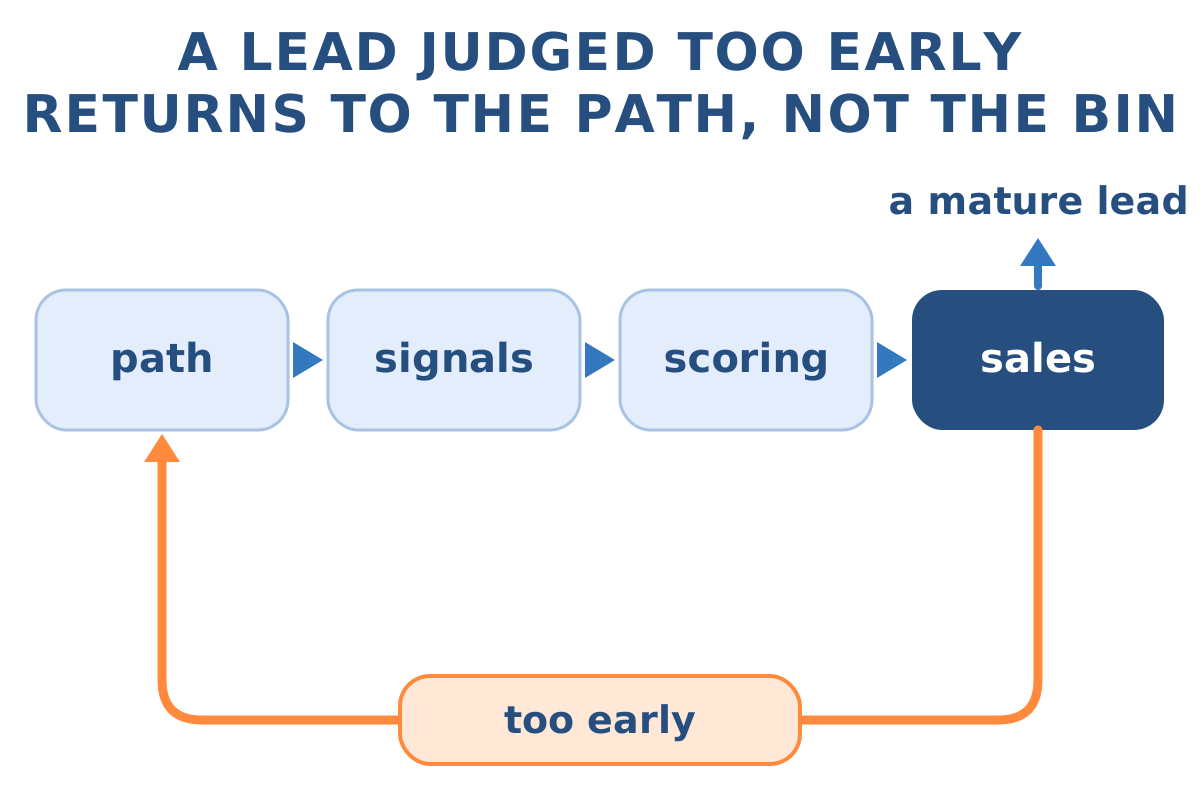
What makes the loop measurable is what each of its four elements is set to.
The lead enters a path
matched to its source and stage — one sequence after a guide download, another after a product webinar.
The system delivers material and watches the response
opens, clicks, pages visited. This digital body language shows how engagement is changing.
Scoring converts signals into status
rising activity raises the score, and crossing the threshold turns the lead into an MQL. The scoring mechanics are covered in the qualification guide.
A mature lead moves to sales
and if the salesperson judges the timing early, the contact returns to a path with its CRM status set back to nurturing, keeping its history intact.
How do you design a lead nurturing campaign?
A nurturing campaign is built in five steps, and the fifth is the one most often skipped.
Divide the base by stage and need
A fresh lead, a lead after a sales call and a dormant lead need different paths. One sequence for everyone is the most common cause of unsubscribes.
Match material to stages
Top of funnel: material that defines the problem. Middle: comparisons and webinars. Bottom: case studies and demonstrations.
Design the sequence and cadence
Several messages spaced days or weeks apart. Less frequent but regular contact outperforms daily pressure — nurturing accompanies a decision rather than crowding it.
Choose the channels
Email is the core; remarketing and social keep the brand present between messages. Email's own mechanics are covered in the cold email guidance on copy and deliverability.
Set the exit thresholds
A path has to know when it ends: the lead matured and crossed the score threshold into sales, or the lead went quiet long enough to move to an occasional-contact base.
What are the different types of lead nurturing campaigns?
Five campaign types cover most B2B needs, and they differ by trigger rather than by content format.
Welcome and onboarding
Triggered by a first conversion. Its job is to set expectations and establish why future messages are worth opening.
Educational paths by topic
Triggered by a subject-matter interest. It carries a lead who is still defining the problem toward a defined solution category.
Product and evaluation paths
Triggered by bottom-of-funnel behaviour such as a specification page or a pricing page. It supplies evidence: comparisons, case studies, implementation detail.
Re-engagement
Triggered by a period of silence. It offers a fresh reason to return — a report, a regulatory change, a product release — and honestly acknowledges the gap.
Recycling after a closed opportunity
Triggered by the calendar rather than by behaviour, and distinctive to B2B. The customer pool is finite and needs recur on a cycle — service, parts, expansion, replacement — so a lead returns to a path as the installed product nears the end of its life, with the trust from earlier contact still in place.
The last type is the one most often absent and the cheapest to add, because every contact in it has already been paid for once.
What content feeds lead nurturing?
Match content to the stage rather than to the product, because a lead still naming its problem moves away from an offer and toward an explanation.
Top of the path, educational material works: the lead is defining the problem. In the middle, comparisons of methods, webinars and material showing the route to a solution carry the most weight. At the bottom, evidence decides — a case study from a comparable company, a demonstration, a specific quotation.
Personalisation reaches deeper than a first name in a subject line: the content of the next message follows from what the lead did with the previous one, so a click on implementation detail opens a different path from a click on pricing. From the laboratory's practice, the effect of that depth is large — a personalised B2B newsletter runs materially above a generic one, and combining personalisation with localisation roughly doubles engagement against the generic baseline (drySEO lab data, directional from practice rather than an export; the underlying figures are open rates, which are an auxiliary signal rather than a measure of purchase readiness).
What is the difference between lead generation and lead nurturing?
The boundary falls at the moment a contact is acquired. Lead generation works before it, attracting strangers and converting them into contacts with details attached. Lead nurturing begins after it, taking an acquired contact and carrying it to purchase readiness.
Confusing the two is expensive in both directions. Sales material sent to a cold audience behaves like untargeted lead generation, and acquisition running without a nurturing programme leaves freshly bought contacts to cool while a competitor stays in touch with them. Keeping the two separate in the reporting also keeps the diagnosis clean: a weak result belongs either to the top of the funnel or to the interval after it, and one number rarely tells you which.
How does lead nurturing run inside a CRM?
Nurturing runs inside a CRM as a set of statuses plus the rules that move leads between them, which is why the CRM rather than the email tool is the system of record.
Three mechanisms carry the work. Status fields hold where each lead stands, so a lead returned by sales resumes a path with its history intact. Scoring rules convert behaviour into a number and change status at a threshold. Automation rules deliver the material, apply score decay to contacts who have gone quiet, and timestamp each handover so the interval becomes measurable.
Artificial intelligence extends this by predicting which leads will mature fastest and by selecting content, working on patterns learned from won and lost deals. The division of labour stays the same in either case: the delivery is automated, and the relationship is carried by what the delivered material is worth.
How do you measure lead nurturing?
Measure nurturing on three figures, each answering a different question about the paths.
Share of leads progressing from nurturing to MQL or SQL
whether the paths mature anyone at all.
Maturation time
how long a lead takes from entering a path to crossing the threshold. Read against the distribution above, this says whether the programme reaches the part of the cycle that runs past the first month, or only harvests the fastest part of it.
Reactivation rate
how many dormant contacts return to activity, which is the metric that justifies the recycling path.
Opens and clicks are auxiliary signals. They describe readership, while the purpose of the programme is purchase readiness, and a path can produce excellent engagement among people who will never buy.
Frequently asked questions
Does nurturing work on an old, cold base?
Yes, and it is among the cheapest moves available in B2B, because the acquisition cost of those contacts has already been paid. The conditions are a genuine new reason for writing and an honest reset of the relationship; resuming a dormant list as though no gap had occurred produces a wave of unsubscribes.
Does nurturing work the same way in B2B, B2C and SaaS?
The principle is shared and the weight differs. B2B nurturing is the longest and most substantive, because decisions take weeks and involve a committee. SaaS extends it into trial and onboarding, since retention matters as much as the purchase. B2C and ecommerce use short forms — abandoned cart, upsell, loyalty — with less education and more timing.
What are the most common mistakes?
Offering too early, so the second message teaches the reader to ignore the sender. One path for everyone regardless of stage. Missing exit thresholds, leaving leads circulating in sequences for years and depressing every statistic measured on them. A cadence dense enough to exhaust patience, which is costly because an unsubscribe is permanent. And the expensive one: closing a lead after a month of silence, which hands a competitor the part of the distribution where most of the result is decided.
How many messages should a sequence contain?
Enough to carry a lead through the observed follow-up count above, spaced to match a buying cycle measured in months rather than days. The count matters less than the exit thresholds, which determine whether the sequence stops for the right reason.