
Real estate lead generation is the work of turning people who want to buy, sell or rent a property into named contacts your agents can call. The lead itself is a narrow thing: an enquiry about a specific listing, or consent to be contacted about a future one. Everything else on this page follows from one fact about the category — transaction values are high and decision cycles are long, so a brokerage wins on the quality and handling of a small number of enquiries rather than on the volume of a large number.
What is real estate lead generation?
Real estate lead generation is the set of channels and processes that produce enquiries from buyers, sellers, landlords and tenants, and the handling that keeps those enquiries alive until a transaction closes. Two attributes decide what any single lead is worth, and both are worth naming before any channel discussion begins.
The first is intent. A person who has typed a postcode and a price range into a search engine and then asked about one specific listing has told you what they want. A person who downloaded a market report has told you they are interested in the category. Both are leads; they belong in different queues and they justify different amounts of an agent's time.
The second is exclusivity. A lead that arrives at your brokerage alone is a conversation. The same lead sold simultaneously to five brokerages is a race, and the prize goes to whoever dials first rather than to whoever is the better fit. This distinction matters more in real estate than in most categories, because the product — a given property, or a given seller's mandate — is genuinely unique, and the client can only transact once.
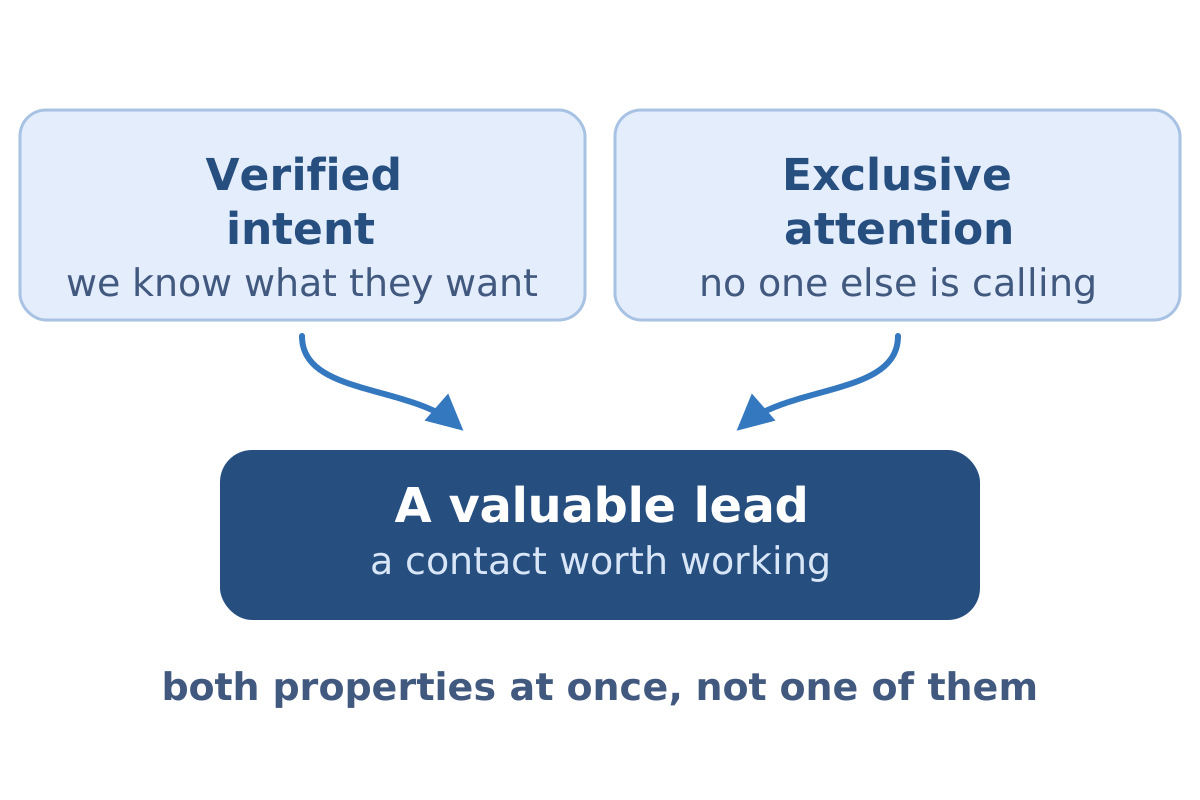
A useful working definition follows from those two attributes: a valuable real estate lead is a contact whose intent has been verified and whose attention you are not sharing. Everything a brokerage does in marketing either improves those two properties or increases volume at their expense.
Where do most realtors get their leads?
Most real estate leads come from four sources that behave very differently: search, listing portals, referrals from past clients, and paid campaigns. The useful question is not which one is best in the abstract, but which one produces contacts you own, at a cost your transaction value supports.
Search
produces the highest-intent enquiries a brokerage can get without paying per contact. Someone searching for property in a named district, or for a guide on selling an inherited flat, has begun the process on their own initiative. The enquiry that follows starts from a formed need rather than from an interruption, which is why organic contacts tend to survive the first phone call better than contacts produced by broad advertising.
Listing portals
deliver volume and, in most markets, a large share of a brokerage's raw enquiry count. They also set the terms: the portal owns the relationship with the searcher, the enquiry may be shared, and the cost is recurring. Portals are worth using; they are a poor thing to depend on exclusively, because a brokerage that stops paying loses the pipeline in the same month.
Referrals and past clients
are the cheapest and the most reliable source in the category. A person who was well served three years ago and who is now moving again arrives with no acquisition cost and with the trust already in place. The mechanism is worth building deliberately: a record of every past client, a reason to contact them that is not a sales pitch, and a schedule.
Paid campaigns
buy attention immediately and stop the moment the budget stops. Their proper role is to cover gaps — a new development that needs enquiries this quarter, a district where the brokerage has no organic visibility yet — rather than to serve as the permanent floor of the pipeline. The planning of a campaign of this kind, from objective to measurement, is set out on the campaign planning page.
How can real estate agents generate leads effectively?
Effective real estate lead generation combines channels that produce different kinds of contact, because buyers and sellers enter the market at different moments and through different doors. The four blocks below are the ones that carry most of the result.
Local search and the Google Business Profile
Local search is where a property intention becomes a query, and it is the cheapest entry point into the funnel for a brokerage with a defined territory. Two things carry it. The first is coverage of the queries that combine a property type with a place — the searches people actually run when they start looking. The second is a complete Google Business Profile with genuine reviews, which is what appears in the local pack and on the map before any website does. For a brokerage with one or two offices, a well-kept profile and a handful of district pages outperform a large, generic site.
Content that reaches people before they choose an agent
Content works in real estate because the decision is preceded by a long period of private research, during which the client has no agent to ask. Guides on preparing a property for sale, honest local market commentary, neighbourhood explainers, video walkthroughs and 3D tours all occupy that period. The commercial logic is simple: the brokerage that answered the question is the one the client contacts when the research phase ends. How search traffic of this kind converts into commercial enquiries, and what has to be true on the landing page for it to happen, is covered in our guide to SEO leads.
Paid campaigns with tight geography
Paid campaigns in real estate work when they are narrow. Location targeting, remarketing to people who viewed specific listings, and campaigns built around a single development or a single seller offer all produce enquiries at a defensible cost. Broad campaigns aimed at everyone who might move house in a city produce volume and very little else, because the audience contains mostly people who will not transact for years.
Referrals, past clients and local networks
Referral generation is a process, not a mood. It requires a record of who was served and when, a reason to reappear that the former client finds useful, and someone whose job it is to do this. Local networks — mortgage brokers, solicitors, renovation firms, relocation managers — meet people at the exact moment a property decision starts, and a reciprocal arrangement with them produces contacts with the intent already verified by a trusted third party.
Why does speed of response decide the outcome?
Speed of response decides outcomes in real estate because the client contacts several brokerages at once and forms an opinion during the first conversation they manage to have. This is a structural feature of the category rather than a matter of etiquette: the enquiry is about a specific property, several agencies can show that property or one like it, and the first substantive answer frames every comparison that follows.
Two consequences follow for how a brokerage is organised. Automatic notification of new enquiries, routed to a person rather than to a shared inbox, is worth more than an additional campaign — because it raises the yield of every enquiry already being paid for. And a defined first response, with someone accountable for it during business hours, turns speed from an individual habit into a property of the firm.
The pattern also changes what follow-up has to look like. From drySEO lab practice — directional observations from experience, distinct from the measured figures elsewhere on this site, which carry denominators — a new client typically converts after the fifth contact, and sequences running to twelve follow-ups are common. The operational point transfers regardless of category: a cadence of five to twelve touches has to be held by a system. What that system needs to do is set out in the automation guide.
How do you qualify a real estate lead?
Qualifying a real estate lead means establishing three things before an agent commits time: what the person actually wants, whether they can complete the transaction, and when. Each has a practical test.
What they want
is established by the enquiry itself and by one or two questions. A buyer looking in three districts at two price points is at a different stage from a buyer who has asked about one apartment twice.
Whether they can complete
is the question brokerages most often skip and most often regret skipping. Financing status for a buyer, and ownership and title status for a seller, determine whether a pleasant conversation can become a transaction at all.
When
determines the queue rather than the answer. A seller who will list in nine months is not a bad lead; they are a lead for the nurture sequence rather than for the viewing calendar, and the brokerage that stays in contact for those nine months usually gets the mandate.
Defining who the brokerage is trying to reach in the first place — the segments, their circumstances and the language they use — is the upstream half of this work, covered in Target Audience.
How do you measure real estate lead generation?
Real estate lead generation is measured with three numbers per channel: the cost of acquiring a lead, the share of leads that become transactions, and the return that follows. The value of doing this by channel rather than in aggregate is that the answer is frequently counter-intuitive — the channel with the cheapest contacts is often not the channel with the most transactions.
One measurement discipline transfers from technical B2B work and is worth importing wholesale, because brokerages consistently get it wrong. Advertising and analytics panels report only what they can attribute, and they attribute less than actually happens. In drySEO lab data, comparing enquiries carrying a campaign parameter in the CRM against the conversions reported by the advertising panel gives a ratio of 1.4–1.9×, and always in the same direction: the panel sees fewer (denominator: campaign-parameter leads in the CRM ÷ conversions reported by the panel; a control from a third system agreed within 0.4 percentage points; drySEO lab data, measured on a B2B inbound account). The practical rule is to treat any panel figure as a lower bound and to make budget decisions only after reconciling it with the system where transactions are recorded.
A second discipline concerns the denominator itself. A conversion rate is meaningless without a statement of what was divided by what: enquiries divided by all site visitors is a different number from enquiries divided by visitors to listing pages, and both are legitimate. The measurement stack that makes these comparisons possible is described in the lead conversion guide.
What role do technology and AI play in real estate lead generation?
Technology in real estate lead generation does three jobs: it stops enquiries being lost, it sorts them, and it shortens the time between enquiry and first human contact. Each is worth separating from the marketing claims that surround the category.
Not losing enquiries
is the CRM's job and the highest-return one. A single record per contact, with source, history and next action, removes the failure mode that costs brokerages the most: an enquiry that arrived, was read on a phone, and was never entered anywhere.
Sorting
is what scoring does. A model that ranks contacts by budget signals, engagement and stated timing lets a small team spend its hours on the contacts most likely to transact. The scoring is only as good as the data behind it, which is the argument for disciplined record-keeping rather than an argument against scoring.
Shortening time to contact
is where conversational tools earn their place. A qualification chat on a listing page that runs outside office hours captures the intent while it exists and hands a structured summary to an agent in the morning. Generative tools also compress the production of listing descriptions and personalised follow-up messages, which raises the number of contacts a given team can sustain.
The through-line is that each of these amplifies a process that already works. A firm that loses enquiries by hand will lose them faster with better software; the sequence is to fix the handling first and then automate it.
How long does it take before these channels deliver?
The channels divide cleanly by time-to-effect: paid campaigns produce enquiries within days, referral systems within a quarter, and search within months. A brokerage building a pipeline from nothing usually runs paid campaigns to fund the present while search coverage and a referral process are built for the future.
That sequencing question — what to start, in what order, and how to fund the period before the slower channels mature — is the substance of the work described in our SEO and SEM services.
FAQ
Should a brokerage start with paid campaigns or with search?
Both, in that order of visible effect. Paid campaigns produce enquiries in the first weeks and pay for the period during which search coverage is being built; search then lowers the marginal cost of each additional enquiry and keeps working when campaigns are paused. Treating them as alternatives is the common error, since they answer different questions: one buys the current quarter, the other buys independence from the advertising budget.
Can a brokerage buy a ready-made database of property clients?
Buying contact lists without marketing consent creates a legal exposure under data protection rules and damages sender reputation, which costs more than the list is worth. The lawful route is buying fresh, exclusive leads from suppliers who obtained consent themselves, subject to the exclusivity test set out at the top of this page — or building owned channels, which is slower and produces contacts nobody else is calling.
What makes a shared lead worth less than an exclusive one?
A shared lead converts worse because the client's attention is divided from the first minute and the conversation starts as a comparison rather than as a consultation. The price difference between shared and exclusive leads is therefore the wrong comparison; the useful comparison is cost per transaction, which is what makes exclusivity affordable at prices that look high per contact.