

Lead generation for tech companies has one defining characteristic: the buyer is technical and verifies your competence long before the first conversation. They read documentation, compare approaches and work out who actually understands the problem. The general rules of B2B lead generation hold here too, but the technology sector plays them its own way — and the sector is not one market but three.
What is lead generation for tech companies?
Lead generation for tech companies is the process of turning technical research into named commercial enquiries from organisations evaluating software, services or engineered systems. Three features define it.
The audience knows the subject
The decision-maker, or the person advising the decision-maker, is an engineer who distinguishes competence from marketing in about two minutes. Technical content is therefore the currency of trust, and there is no substitute that works on this reader.
The cycle is long and the decision is collective
Choosing a technology supplier is a multi-year commitment — it constrains hiring, architecture and budget — so organisations buy carefully and in groups.
The competition is global
A regional software house and a platform from a major technology hub can compete for the same enquiry, which raises the standard required of both content and visibility. Distance is not a defence in a market where evaluation happens in a browser.
The sector is also not homogeneous. Acquiring clients for IT services works differently from acquiring users for a SaaS product, which works differently again from selling complex hardware. The three are separated later on this page, because conflating them is the most expensive planning error in the category.
How do you target the right technology decision-makers?
Targeting in technology starts with an ideal customer profile and then layers role personas on top of it, because the organisation qualifies and the individuals decide.
The ideal customer profile names industry, scale and business model, and — specifically for technology — the existing technology stack. What a prospect already runs determines both whether your offer fits and what integration will cost, which makes the stack a harder qualifying criterion than company size.
Three role personas then sit on top of that profile:
The technical role
CTO, lead developer, architect — evaluates architecture, security and risk. This role can veto, and usually does the initial research.
The business role
the executive who owns the budget — evaluates outcome, payback and vendor stability. This role approves.
The user role
the team that will live in the product — evaluates whether daily work gets better. This role decides renewal, which is where the value in a subscription business actually sits.
Writing one message for all three produces a message that persuades none of them. How these profiles are constructed, and how segments are drawn from them, is covered in B2B Target Audience.
Where the realistic buyer universe is dozens of accounts rather than thousands — typical in enterprise technology sales — this targeting extends naturally into working a named account list rather than a market.
Which channels drive the most leads for B2B tech?
Four channels produce most of the pipeline in technology, and their common feature is that each one lets the buyer verify something before committing to a conversation.
Technical content and search
Search is where a technical evaluation begins, and content that genuinely helps is the cheapest entrance to the funnel a technology company has. The formats that work are problem-led guides, honest comparisons of approaches, architecture notes and open documentation. The mechanism is specific to this audience: an engineer who has been helped once, for free, without a form, extends provisional trust to the organisation that helped them. How that search traffic converts into commercial enquiries is set out in our SEO leads guide.
Narrow paid campaigns with something to collect
Paid search works in technology when it runs on precise problem-shaped queries and lands on a page offering something concrete. What converts here is an exchange of substance: a technical workshop, an audit, a benchmark, a working tool. Broad campaigns aimed at job titles produce clicks from people who are not evaluating anything.
Professional networks and technical communities
Two different motions share this channel. Social selling reaches technical and business roles directly and works when the outreach references something real about the recipient's situation. Community presence — developer forums, events, open source — works on a longer horizon and produces the warmest contacts in the category, because reputation there is earned in public and cannot be bought.
Researched outbound email
Cold email works in technology when the list is narrow and built on genuine criteria — stack, scale, a recent signal — and when the message refers to the recipient's actual context. The same message sent to ten thousand addresses produces complaints and domain damage. The rules that keep this channel viable are set out on the cold email page.
What is the 5-minute rule for leads?
The five-minute rule is the working principle that a lead contacted within minutes of enquiring converts far better than the same lead contacted hours later, because the buyer is still engaged with the problem that prompted the enquiry. It circulates widely as a specific statistic; the figures attached to it vary between sources and this page does not repeat any of them, because none is traceable to a measurement whose denominator is published.
The mechanism, however, is sound and does not need a statistic to be actionable. A technical buyer who has just submitted a form is at the peak of their context: the tabs are open, the comparison is live, the question is formed. An hour later the context is gone and has to be rebuilt; a day later a competitor has often supplied it.
What follows for a technology company is organisational rather than tactical. Enquiries route to a person, not to a shared inbox. Someone owns first response during business hours. And the first response is technical — an answer to the question asked — rather than a scheduling request, because this buyer measures you by the quality of the first substantive exchange.
How do lead generation differences play out across IT services, SaaS and high-tech?
The three sub-markets of technology differ in where conversion happens and how fast the funnel moves, and each requires a different primary asset.
IT services — software houses, integrators, consultancies
The client is buying a team and the confidence that it will deliver. Leads come from references, implementation case studies and demonstrated expertise, and enquiries frequently compare several suppliers at once. The decisive asset is evidence of delivered projects: what was built, under what constraints, with what result.
SaaS — a product on subscription
The game is volume, and the funnel leads to a trial or a demo. Part of the qualification is performed by the product itself: a user who has configured a trial has done work that a casual contact never does. In a product-led model the product becomes the main acquisition channel and marketing's job is to supply it with traffic.
High-tech — hardware and complex engineered systems
This sits closest to industrial selling: a buying committee, formal specifications, a long cycle and high contract value. Technical documentation, standards compliance and reference installations carry the decision. The mechanics are largely shared with manufacturing, and are set out in Industrial Lead Generation.
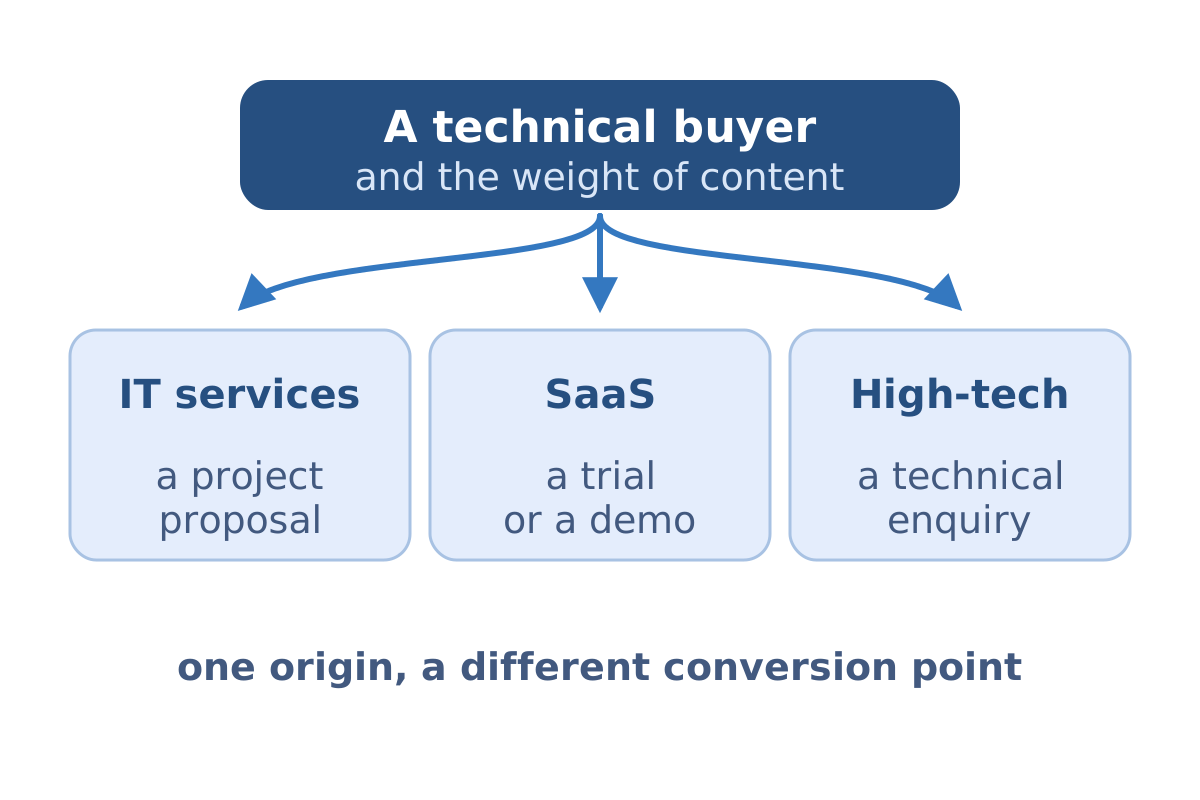
Consolidating: what is common is the technical buyer and the weight of content. What differs is the conversion point — a project proposal, a trial signup, a technical enquiry — and the speed of the funnel.
What role does AI play in lead generation for technology companies?
Artificial intelligence changes three parts of technology lead generation: how prospects are researched, how messages are personalised at scale, and increasingly how buyers find suppliers in the first place. The third is the one with strategic consequences.
Research and enrichment
is the least glamorous and highest-return application. Matching a prospect list against stack signals, funding events, hiring patterns and public technical output produces a narrow list with a real reason to make contact, which is the precondition for outbound working at all.
Personalisation at scale
lets a small team sustain the contact cadence the category requires. The constraint is that personalisation generated without substance reads as generated, and this audience is unusually good at detecting it.
Discovery is moving
a growing share of technical evaluation begins in conversational AI interfaces, where an answer is composed rather than a list of links returned. That changes what visibility means for a technology supplier: the asset is content structured to be quotable, carrying information a model cannot synthesise from everyone else's marketing. What that requires in practice is set out in our AI SEO guide.
How should technology companies measure lead generation success?
Technology companies should measure lead generation on commercial enquiries and on the share of those enquiries that become orders, with an explicit denominator attached to every rate. Rates without denominators are the reason two teams can report different numbers for the same quarter and both be right.
The measured reference from drySEO lab data is a close rate of 13.6% from commercial enquiry to order in inbound B2B (denominator: orders ÷ commercial enquiries after noise removal; the value moves between 11.6% and 15.0% depending on how the denominator is drawn; drySEO lab data). Two things are worth taking from this figure. The first is its magnitude: roughly one enquiry in seven becomes an order, which sets what a pipeline has to contain to hit a target. The second is the range — the same underlying reality yields 11.6% or 15.0% depending on a definitional choice, which is why the denominator travels with the number everywhere it appears.
The second measured reference concerns the funnel template that circulates as common knowledge. The familiar composition of 5% site conversion, 30% qualification and 15% close collapses at the first threshold when checked against measurement: the first step is 6–7× too high for a knowledge site (measured at 0.8% of all site users, or 0.7% after noise removal; denominator: all site users ÷ commercial enquiries in the CRM; drySEO lab data), while the close rate is higher than the template assumes. The practical instruction is to measure each threshold separately with its own denominator, because 5% describes a campaign landing page and a knowledge site runs on a different number entirely.
A third measurement point is structural: advertising panels under-report. In drySEO lab data the ratio of campaign-parameter enquiries in the CRM to conversions reported by the panel is 1.4–1.9×, always in the same direction (denominator: campaign-parameter leads in the CRM ÷ panel conversions; a control from a third system agreed within 0.4 percentage points; drySEO lab data). The metric definitions that make this reconciliation possible are covered in the lead conversion guide.
How do you nurture technical leads through a long cycle?
Technical leads mature against the stages of the buyer's own decision — proof of concept, budget cycle, executive approval — so nurturing supplies technical material during that period rather than commercial reminders. Architecture notes, comparisons, implementation results and benchmark data all give the internal champion something to circulate, which is the actual job: the champion has to sell you internally when you are not in the room.
One observation from drySEO lab practice describes the contact cadence. It is directional — a pattern from inbound B2B experience, distinct from the measured figures above, which carry denominators. Conversion of a new client typically follows the fifth contact, with sequences running to twelve follow-ups. Its operational consequence is concrete: a quiet lead at week five is normal, and a cadence of five to twelve contacts has to be held by a system.
Measuring the decision window. That window is long. Measured on the lab's last thousand leads, cumulatively: 7.07% of closings came within 3 days, 41.65% within 45 days and 65.96% within 75 days (drySEO lab data — closings ÷ time since the lead's entry; a share of closings, not of leads). Fewer than half of all closings have happened by day 45, and a third of them arrive after day 75.
One pattern specific to technology is worth building deliberately: nurturing the enquiries you lost. A company that chose a competitor returns to the market at the first serious friction, and the supplier who stayed in useful contact during the intervening period is the one they call.
What are the most common mistakes in tech lead generation?
The four recurring failures in technology lead generation are all mismatches between message and reader.
The first is technical jargon aimed at non-technical decision-makers — the executive buys an outcome, not an architecture. The second is its mirror image: marketing language aimed at engineers. The third is a site organised around the product instead of around the customer's problems, when the buyer searches for their problem and not for your feature list. The fourth is the absence of case studies with numbers, which is the only form of evidence this sector fully trusts.
Building the search, content and measurement layers that avoid all four is the work described in our SEO and SEM services.
FAQ
Does product-led growth replace lead generation?
Product-led growth moves the conversion point rather than removing it. The product qualifies users itself, but traffic to the product still has to be acquired through content, search and referral, and enterprise deals run a conventional commercial process alongside the self-service motion. It is a variant of the funnel rather than its absence.
How do you generate technology leads in foreign markets?
Through the same channels, adjusted for language and evidence: content and search in the target market's language, case studies that make sense without local context, and lists built per market. The binding constraint is credibility rather than channel, which is why the first few references in a new market are worth more than the advertising budget that could have been spent instead.
Should a technology company hire an agency or build an internal team?
The question is better framed as which capability has to be permanent. Market knowledge of your own buyers, and the technical substance of the content, have to live inside the company because they are the product of your engineers' experience. Execution — search infrastructure, measurement, campaign operation — is transferable and can be built or brought in. The failure mode is outsourcing the substance and keeping the execution, which produces fluent content that technical readers discard.