
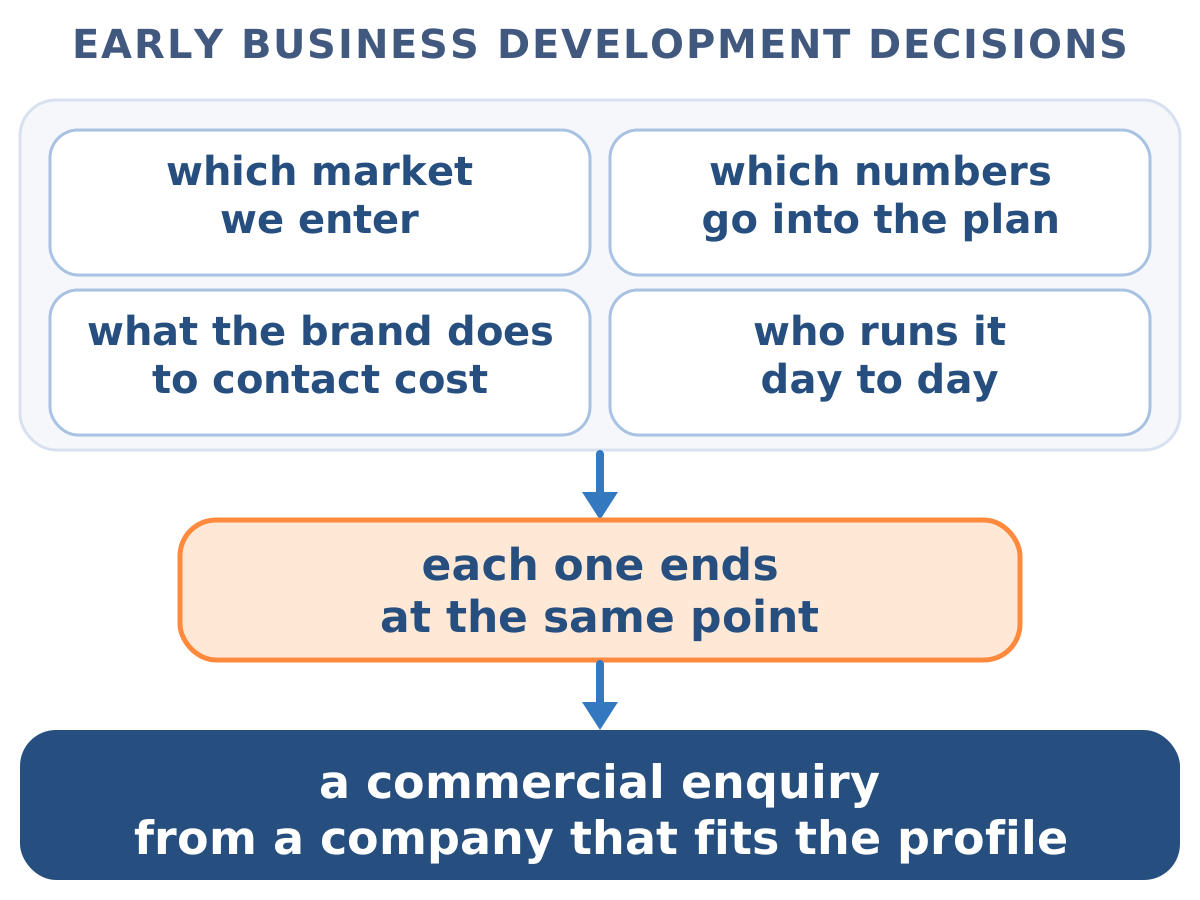
Business development through lead generation is the organised identification and qualification of buyers, which turns revenue growth into something repeatable. In B2B that mechanism rests on four decisions taken early: which market to enter, which numbers go into the plan, how the brand affects the cost of a contact, and who inside the company runs the process day to day.
This page sets out those four decisions. Each of them ends at the same point — a commercial enquiry from a company that fits the customer profile. The execution layer behind each thread belongs to its own page, and the links in the text lead there.
The strategic pillars of B2B business development
The foundation of B2B business development is the quality of the contacts acquired, and only then their number. Whether the model scales depends on the organisation's ability to identify, repeatedly, the companies that match its expansion strategy — the ideal customer profile works as the filter that points the budget at segments with a predictable return and shortens the time to break even. The value proposition acts as a second filter: a message built around the economics the decision-maker answers for — lower cost, shorter implementation, contained risk — attracts contacts that close at a higher rate, while a catalogue of product features attracts incidental traffic. Both decisions take effect before the first unit of campaign spend, and both settle the economics of the entire funnel.
The methods, channels and metrics behind that process — from first contact to the enquiry handed over to sales — are set out stage by stage in the lead generation guide.
Go-to-market strategy as the frame for lead generation
A go-to-market strategy draws the boundary inside which leads may be sought: it defines the target market, the monetisation model and the distribution channels, and the acquisition process inherits all three. Where the market-entry plan and the acquisition process say different things, the funnel runs at full power on segments with a depressed margin — the financial result holds still while costs climb.
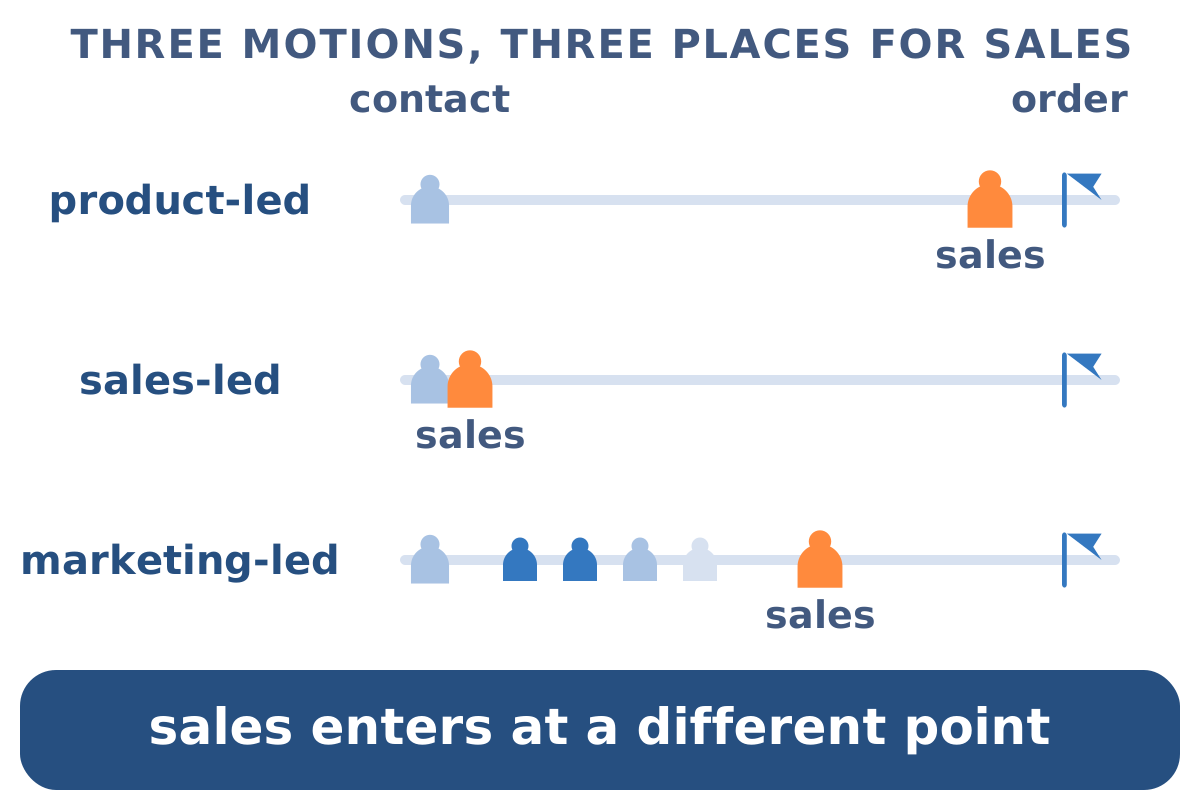
The growth model settles where contacts will actually come from. In a product-led motion the user reaches conversion alone and sales enters on the largest contracts. In a sales-led motion the contact is formed in a relationship and requires a team that can hold long negotiations. In a marketing-led motion the volume of contacts from content and campaigns is what counts, and the measure of health is the cost of a lead over time. Matching the model to how the target audience prefers to buy is what decides whether the funnel can scale at all.
The stage of market adoption changes the definition of a good lead. The first beachhead market supplies references and closes fastest, so early qualification criteria reward an appetite for experiment. Entering the mainstream market shifts those criteria toward implementation evidence and safety of decision. The testing phase before launch — a pilot, a minimum version, trials of the message on a landing page — verifies the conversion assumptions while the main media budget is still unspent.
The market-entry plan and the map of markets that actually ask are two different things, and the gap between them shows up in the numbers. On one B2B account, advertising reached 22 countries, commercial enquiries arrived from 185, and organic traffic from 243 (drySEO lab data; countries counted separately for ad spend, for enquiries in the CRM and for organic entries). A knowledge site draws demand from markets nobody spent a penny on, so a go-to-market plan narrowed to the markets that carry a media budget leaves out most of what is already knocking.
When the target market narrows to a few dozen companies, the sensible go-to-market answer is to treat each account as a market of its own, with its own research and its own material. That way of working with a narrow account list is covered in Account-Based Marketing.
Lead generation in a business plan
In a business plan, the description of lead generation serves as evidence: it shows that the revenue in the forecast has its source in a countable process. The chapter forces a figure for the cost of a lead and the cost of a customer, and conversion between stages — and the distinction between a marketing-qualified and a sales-qualified contact says more about the maturity of the planning than any statement of campaign reach.
An investor reads the section in layers, and each layer answers a different question.
| Layer of the description | What it contains | What it proves |
|---|---|---|
| Market and customer | Segmentation, customer profile, the sizes behind the addressable market | A realistic revenue ceiling |
| Channels | The split between building content assets and direct outreach | A fit with the company's stage and budget |
| Infrastructure | Contact management system, automation, data hygiene, consent records | Operational readiness at scale |
| Numbers | Cost of a lead, cost of a customer, conversions, sales cycle | The economic feasibility of the model |
Caution pays in the last row. A cheap contact and a cheap customer are two different quantities — the channel with the lowest cost per contact is quite capable of delivering the most expensive customer, so the forecast needs an explicit denominator beside every figure. Enquiry-to-order conversion in inbound B2B runs at 13.6%, counted as orders ÷ commercial enquiries with noise filtered out (drySEO lab data); a forecast built on that order of magnitude survives the conversation with an investor. The long B2B sales cycle also opens a cash gap between the spend and the receipt, so the financial plan reserves working capital for the payback period.
How far that difference reaches shows on a single line of the plan. Cost per lead in one account and one period comes to PLN 73, PLN 237 or PLN 452 — depending on whether the geographic cost is divided by all leads from foreign markets, by the leads carrying a campaign parameter, or by the conversions the ad panel reports (drySEO lab data, leads from foreign markets). The 6.2× spread is definitional, not commercial: what changes is the denominator, not the cost. A business plan that quotes one of those figures without its denominator cannot be checked — and an investor who notices will stop trusting the rest of the forecast too.
How the cost of a lead and the cost of a customer are counted, with ranges per channel, is set out on the lead cost page.
Brand positioning and the cost of a contact
Brand positioning lowers the cost of acquiring a contact, because a reader who already associates the brand with the solution to their problem enters the funnel further along and moves faster. A strong position also protects the margin: the commercial conversation then opens on value, and price arrives later and in a different context.
A positioning statement is what disciplines the message at the entry to the funnel. It takes the form: for [audience] [brand] is the [category] that [key benefit], because [evidence]. That sentence works as the constitution of the communication — landing page, call to action and nurture sequence all repeat the same promise. Consistency between the promise and the customer's experience keeps contacts of the right profile inside the funnel; a promise wider than the product raises the cost of acquisition twice, once on the way in and once on the way out.
The effect of positioning is measurable on the funnel side: the share of direct and branded-search entries rises, close rate rises, and the distance from first contact to proposal shortens.
The size of that layer can be read directly. On one B2B account, 22.2% of users began the visit with a direct entry — from the brand name, not from a question about the problem (drySEO lab data; site users ÷ first channel of entry). Enquiries that never went through the form — email and phone — make up 7.8% of all enquiries, and they close at 25.55%, the highest rate in the whole set (drySEO lab data; orders ÷ leads in that pool). That pool cannot be credited to any acquisition channel, though, because it holds returning customers rather than new demand. Brand familiarity therefore shows up as a conversation that starts further down the funnel — not as a cheaper lead, which nobody here has counted.
Search marketing joins both layers — presence on the queries that matter to the industry ties the brand to the solution at precisely the moment a decision-maker is looking for an answer. That execution layer, from content through visibility to conversion measurement, is run as SEO and SEM services.
Where lead generation sits in the marketing function
Inside the company's structure, lead generation lives within promotion and process, as their operational goal. The classic four-part marketing model ties it to communication; the extended seven-part model adds the People responsible for the quality of enquiry handling and the Physical evidence that builds the credibility a reader needs before leaving their details. The order is fixed: the ecosystem first — offer, processes, proof of quality — then the channels.
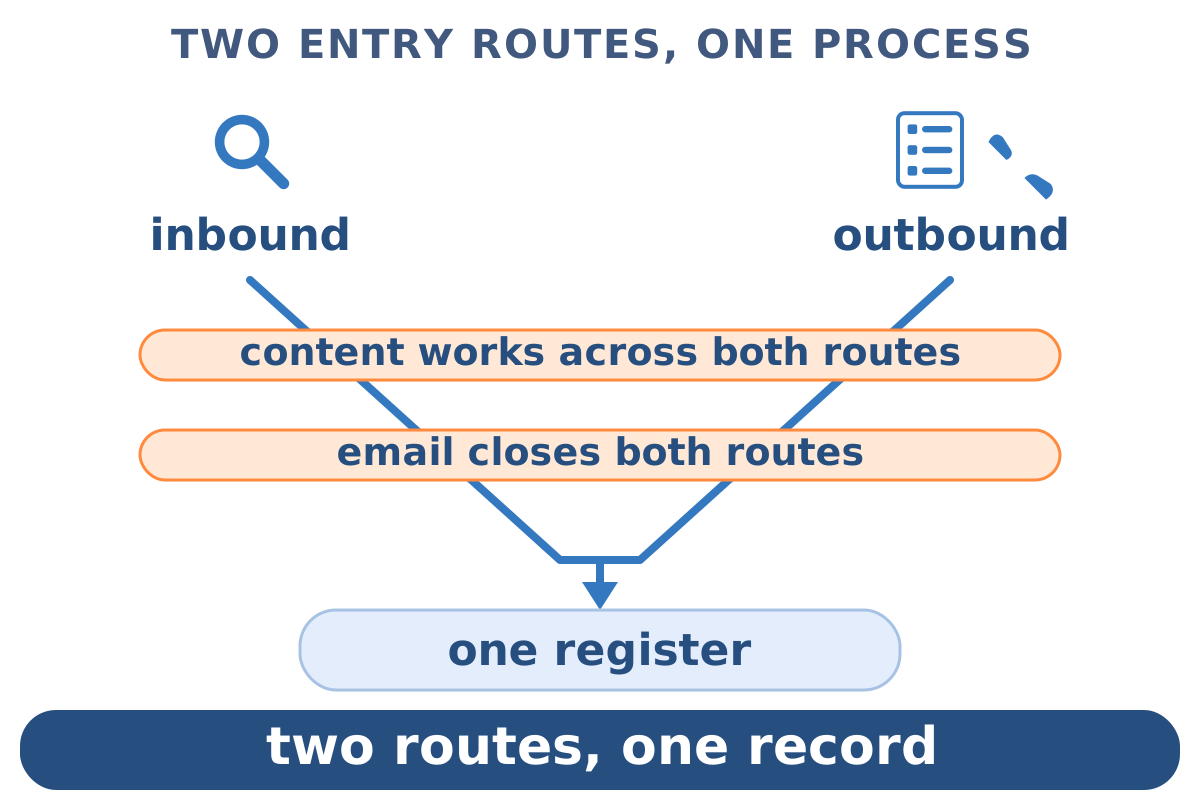
The direction in which communication flows divides those channels into two groups, and a lead enters the same process by either route.
Inbound
Expert content, organic visibility and webinars attract a reader at the moment they are already searching for a solution. These leads carry higher purchase readiness and a longer ripening time.
Outbound
Direct contact, campaigns aimed at a narrow list of companies and social selling give control over the pace at which the funnel is fed. That control counts for an innovation and in niches of a few dozen buyers.
Content
Content works in both directions: it attracts from search and at the same time serves the salesperson as substance in a first conversation.
Email
Email closes both routes: it answers the details left behind and runs the educational sequence through to purchase readiness.
Offline channels
Trade shows, meetings and presentations add personal evidence wherever the contract is closed by trust in the people behind the offer.
Consistency across these channels is held by a shared definition of a qualified contact and by one register in which the history of the relationship is visible regardless of the entry point. Order in that layer — statuses, owners, response times, and continuity of knowledge through staff turnover — is covered in our lead management guide.
Which layer starts delivering leads first
Market, the numbers in the plan, the brand and the structure start delivering leads at different times, and the order is the same every time. The first effect comes from narrowing the market and the customer profile, because it acts immediately on every campaign and every piece of text. The second comes from the numbers in the plan, which point the budget at channels with a countable return. The third is the brand, which lowers the cost of a contact more slowly and more durably. The fourth is structure and process, which hold the pace as the volume of enquiries grows.
There is a layer underneath all four, and it is where most of the market that could buy is standing at any moment: the companies that have the problem and have not yet started looking for a supplier. Reaching them before the search begins is a discipline of its own, covered in Demand Generation.
The last layer is purely practical. Conversion of a new customer most often follows the fifth contact, and sometimes the twelfth — counting contacts with the same reader up to the point of enquiry (drySEO lab data, directional from practice). At scale, that cadence is held only by a planned sequence, which is the work of marketing automation platforms.
FAQ
How does lead generation differ from prospecting?
Lead generation works one-to-many: it attracts a defined audience and earns permission to make contact by distributing material worth reading. Prospecting works one-to-one: a salesperson takes the initiative toward named decision-makers. The two call for different skills, and in a mature process they run in parallel.
Where does the line between a marketing-qualified and a sales-qualified lead fall?
A marketing-qualified lead is a contact that has shown behavioural interest in the offer and awaits verification of its ability to buy. A sales-qualified lead is an organisation that has passed that budget and authority check and is ready for a commercial conversation. The line is drawn by one definition written jointly by marketing and sales, and the criteria for assessing fit and behaviour are set out in the qualification guide.
How does brand positioning differ from search positioning?
They are two complementary processes. Brand positioning is strategic: it builds a particular picture of the company in the customer's mind. Search positioning is technical and editorial: it raises the visibility of the site on chosen queries. In a B2B funnel they work together — visibility supplies the contact, the brand settles how often that contact closes.